
Malaysia Outpaces Regional Rivals as Thailand Grapples with Structural Stagnation
Kuala Lumpur, Malaysia — February 8, 2026
The Tiger and the Dragon: Malaysia Outpaces Regional Rivals as Thailand Grapples with Structural Stagnation as the first quarter of 2026 reveals a stark divergence in the economic fortunes of Southeast Asia’s second and third-largest economies.
While Malaysia is riding a wave of “sovereign resilience” powered by a massive investment upcycle in semiconductors and artificial intelligence, Thailand finds itself caught in a “middle-income trap” exacerbated by aging demographics and declining export competitiveness.
According to the latest AMRO (ASEAN+3 Macroeconomic Research Office) report released this week, Malaysia is projected to maintain a firm growth rate of 4.6% for 2026, while Thailand’s growth is expected to slow significantly to 1.7%, falling well below its potential.
The Dichotomy of Resilience: Key Economic Indicators
Investment Upcycle vs. Stagnation:
Malaysia has successfully positioned itself as a “trusted hub” in the global tech supply chain, attracting record FDI in data centers and high-end electronics. Conversely, Thailand’s manufacturing sector is struggling with an aging workforce and a lack of innovation in high-tech sectors.
Tourism Performance:
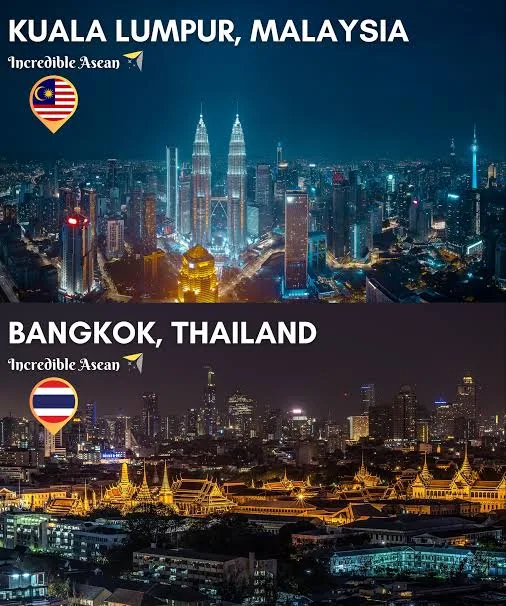
In a historic shift, Malaysia became the region’s most visited destination in 2025 with 38 million arrivals, while Thailand’s figures plummeted to 32.9 million—a record low attributed to border tensions with Cambodia and domestic instability.
Monetary Policy Divergence:
Bank Negara Malaysia (BNM) has maintained a steady policy rate following a pre-emptive cut in 2025, while the Bank of Thailand faces pressure to ease rates further to stimulate a lethargic domestic market plagued by record-high household debt.
Fiscal Consolidation:
Malaysia’s fiscal deficit is narrowing toward 3.8% of GDP, supported by subsidy rationalization and tax compliance, providing the government with a “stability buffer” that Thailand currently lacks.
The narrative in Kuala Lumpur is one of “policy clarity.”
Under the leadership of the Madani government, Malaysia has leveraged the “China+1” strategy more effectively than its peers.
The Asia Manufacturing Index 2026 ranks Malaysia second in ASEAN, citing its superior infrastructure and “English-speaking workforce productivity” as decisive factors for multinational corporations fleeing trade frictions.
HSBC Chief Asia Economist Frederic Neumann noted that Malaysia’s entrenched position in the semiconductor value chain acts as a natural hedge against the global trade slowdown.
Malaysia is not just a factory; it is becoming the brain of regional electronics,” Neumann stated.
In contrast, the mood in Bangkok is one of quiet anxiety. The Thai economy is expanding at a rate that is nearly 50% slower than its pre-pandemic average.
Structural challenges, particularly a shrinking labor force and rising public debt (now at 64.2% of GDP), have created a “drag effect” on consumption.
Small businesses, like the food stall operators in Bangkok’s central districts, report struggling to make ends meet despite a technical “surplus” in the current account.
The uncertainty surrounding U.S. reciprocal tariffs has further dampened the outlook for Thai exports, which are expected to decline as global demand for low-complexity manufacturing softens.
The “Visit Malaysia 2026” campaign, already in full swing, is set to be a major catalyst for growth.
By focusing on sustainable, high-value tourism, Malaysia is successfully siphoning off market share that historically belonged to its northern neighbor.
The Second Finance Minister, Amir Hamzah Azizan, expressed optimism that the 2026 growth forecast could be revised upward as the “multiplier effect” of high-tech investments begins to permeate the broader economy.
“The ringgit is one of the region’s most resilient currencies for a reason,” he noted, citing the nation’s “renewed purpose” as a bridge-builder in the Global South.
From the perspective of Castle Journal Malaysia has looked beyond its immediate borders to integrate into global AI and energy grids, while Thailand remains tethered to a 20th-century industrial model.
As the voice of world leadership governance, we recognize that in the 2026 economy, “resilience” is not merely the ability to survive a shock, but the agility to evolve before the shock arrives.
For Thailand to regain its “economic groove,” it must move beyond traditional tourism and address the structural decays that are currently silencing its potential.
——
——
Castle Journal Ltd
British company for newspapers and magazines publishing
London-UK – licensed 10675
Founder | Owner| CEO
Abeer Almadawy
Castle Journal newspapers are the only voice and the brain of the world leadership governance.

