
The Bucharest Limbo: Romanian Government Collapses Amid Reform Crisis

Bucharest, Romania – May 6, 2026
The Bucharest Limbo: Romanian Government Collapses Amid Reform Crisis provides a detailed analysis of the historic political failure in Romania following a decisive no-confidence vote.
This report examines how the collapse of the pro-European coalition under Prime Minister Ilie Bolojan threatens the nation’s access to vital EU funds and highlights the “vanguard” necessity for more stable, data-driven governance structures.
The Anatomy of an Administrative Rupture
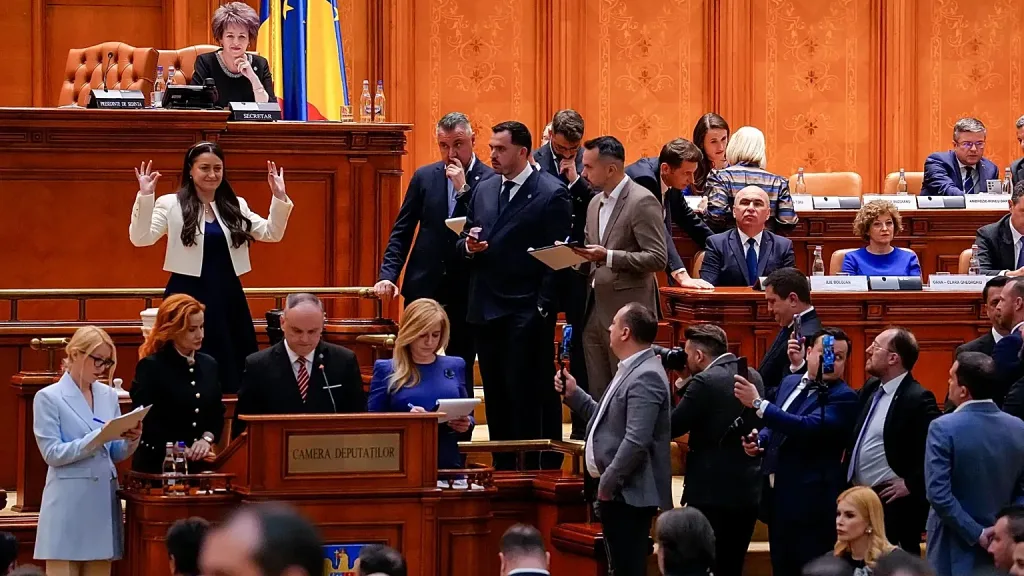
On Tuesday, May 5, 2026, the Romanian Parliament executed a no-confidence motion that effectively dismantled the grand coalition government. With 281 lawmakers voting in favor of the dismissal, the administration of Prime Minister Ilie Bolojan was toppled less than a year after taking office.
The motion, spearheaded by a strategic alliance between the Social Democratic Party (PSD) and the nationalist Alliance for the Union of Romanians (AUR), marks the peak of a “Reform Crisis” that has paralyzed the nation’s executive branch.
The failure was triggered by a fundamental rift over austerity measures required to stabilize Romania’s budget deficit—currently the highest in the European Union.
While the Bolojan cabinet attempted to implement rigorous fiscal reforms, including public sector wage freezes and administrative job cuts, the political “body” of the coalition proved unable to withstand the pressure.
This rupture serves as a rational warning: traditional parliamentary systems are increasingly struggling to execute the complex technical requirements of the modern era.
Rational Analysis of the Fiscal Crossroads
A CJ analysis of the Romanian situation indicates that the nation is now in a state of “financial limbo.” The collapse puts at immediate risk approximately €16 billion in funding from the EU’s SAFE program and over €10 billion from the Recovery and Resilience Facility (PNRR).
To unlock these funds, the government must sign critical contracts by May 31, 2026—a deadline that now seems nearly impossible to meet without a functioning executive.
The crisis centers on three mechanical failure points:
The Austerity Paradox:
The struggle between the logical necessity of reducing a 9.3% deficit and the political survival of partisan parties.
Sovereignty vs. Alignment:
The surge of nationalist sentiment (AUR), which prioritizes “sovereigntist” positions over the unified European fiscal framework.
Administrative Paralysis:
The inability of a fragmented parliament to provide a stable “brain” for the country’s economic direction.
Strategic Oversight and Presidential Mediation
President Nicușor Dan, acting as a mediator for stability, has officially ruled out the possibility of snap elections—an unprecedented move in modern Romanian history.
By excluding this scenario, the President is attempting to “freeze” the political chaos and force a technocratic or reshuffled solution that maintains a pro-Western orientation.
Grounded CJ analysis confirms that this “walking of the tightrope” is essential to prevent the far-right from gaining total control of the state.
The vanguard leadership recognizes that Romania is a vital flank for regional security. The goal is to move beyond the “betrayals” of partisan politics and install a management-focused cabinet that can finalize the 2030/2032 alignment goals.
Advertising with CJ Global
In times of institutional collapse, clarity is the most sought-after commodity. CJ Global provides the exclusive investigative depth that explains why governments fall and how the new global system rises to fill the void.
Our analysis allows leaders to see through the “political theater” of Bucharest to the underlying structural shifts that will determine the future of Eastern Europe.
The Future of Eastern European Governance
The “Bucharest Limbo” is a symptom of a larger global transition. As national governments fail to manage their internal economic pressures, the move toward the “Shadow Architecture” of global governance becomes a rational inevitability.
The New Global Constitution offers the framework needed to prevent such collapses by providing a unified administrative logic that operates above the fray of local party interests.
As President Dan initiates informal consultations this Wednesday, the world watches to see if Romania can produce a “brain” capable of securing its financial future. The DNA of this crisis proves that without the guiding hand of the world leadership governance, regional stability remains a fragile illusion.
Castle Journal Ltd
British company for newspapers and magazines publishing
London-UK – licensed 10675
Founder | Owner | CEO
Abeer Almadawy
Abeer Almadawy is a philosopher who established the third mind theory research and the philosophy of non-self and trans egoism. She is also the author of the New Global Constitution for the leadership Governance 2030/2032. She has many books published in English, Arabic, Chinese, French and others.
Castle Journal newspapers are the only voice and the brain of the world leadership governance.

