China: The “Two Sessions” Opens ; Premier Li Qiang Delivers Work Report
Beijing, China — March 5, 2026
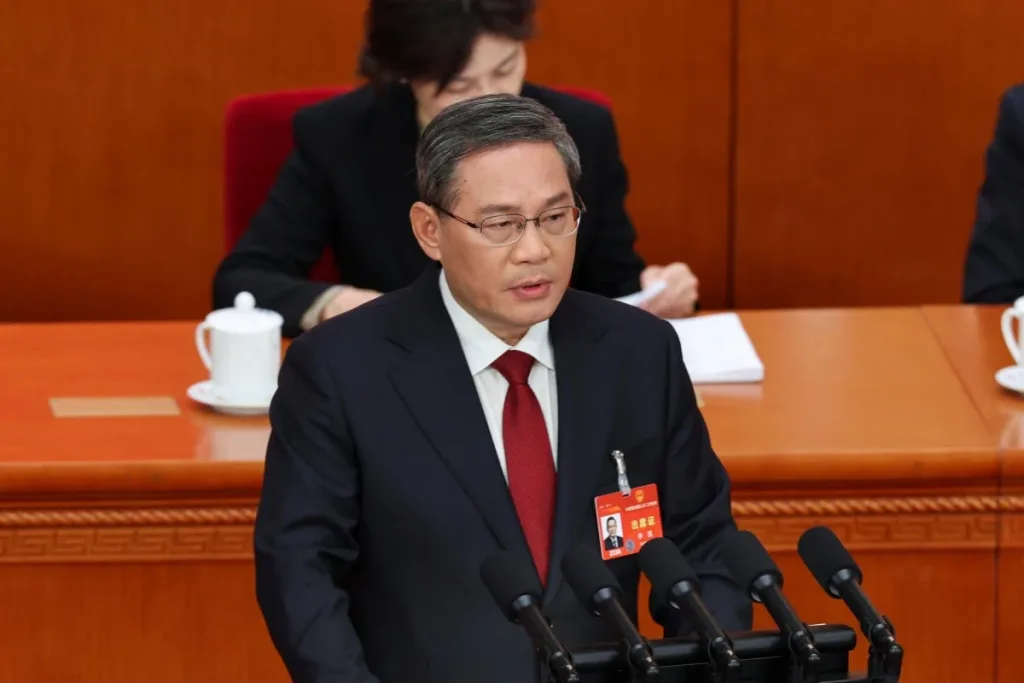
Beijing, China: The “Two Sessions” open at the Great Hall of the People; Premier Li Qiang delivers a work report focusing on a new five-year plan for economic resilience as China positions itself to withstand the global turbulence of the ongoing regional conflict.
As the global spotlight remains fixed on the military escalations in the Middle East, the political heart of the East began its most significant annual event today.
The “Two Sessions”—the concurrent meetings of the National People’s Congress (NPC) and the Chinese People’s Political Consultative Conference (CPPCC)—opened at the Great Hall of the People in Beijing.
Before thousands of delegates, Premier Li Qiang delivered the highly anticipated Government Work Report, unveiling a strategic pivot toward a “Fortress Economy.”
With the world facing a 15% surge in oil prices and a blockade of the Strait of Hormuz, Beijing’s new Five-Year Plan is designed to insulate the world’s second-largest economy through self-reliance, technological sovereignty, and a fortified domestic market.
Economic Resilience: The “Fortress” Doctrine
The centerpiece of Premier Li’s report was the formal introduction of the 2026-2030 Economic Resilience Framework. Recognizing that the era of hyper-globalization has been replaced by one of geopolitical fragmentation, the Premier announced a growth target of “around 5%,” but with a clear shift in emphasis from quantity to quality.
The plan prioritizes “Dual Circulation,” where domestic consumption becomes the primary engine of growth, while foreign trade acts as a secondary, strategic supplement.
“We are entering a period where security and development are two sides of the same coin,” Li Qiang stated.
“Our economic resilience will be built on the bedrock of internal demand and the complete mastery of core technologies. We will not allow external shocks or maritime blockades to dictate the rhythm of China’s progress.”
To fund this resilience, the government announced the issuance of ¥2 trillion in ultra-long-term special treasury bonds, specifically earmarked for energy security and the modernization of the national supply chain.
Technological Sovereignty and AI Integration
A significant portion of the work report was dedicated to the “New Three” industries—electric vehicles, lithium batteries, and solar products—while adding a “Fourth Pillar”: Sovereign AI.
Premier Li emphasized that China must achieve 100% domestic supply chain independence in high-end semiconductors and artificial intelligence by 2028.
This move is a direct response to the “unforeseen” advancement of Western military operations, which has highlighted the vulnerability of nations reliant on Western-controlled satellite and data networks.
The Premier’s report also highlighted the success of the “Digital Yuan” (e-CNY) in international settlements. As the “Gold Bridge” and other alternative settlement systems emerge due to the Middle East war, Beijing is positioning the e-CNY as a stable alternative for global trade, particularly for oil and gas imports from Russia and Central Asia.
This “financial sovereignty” is seen as essential for protecting the Chinese economy from the secondary sanctions that often accompany Western-led conflicts.
Energy Security: The Shift to the North
Given the total blockade of the Strait of Hormuz, energy security was a dominant theme. Premier Li announced an acceleration of the “Northern Energy Corridor,” involving expanded pipelines from Russia and increased coal-to-gas conversion projects in Inner Mongolia.
While China remains committed to its long-term carbon neutrality goals, the 2026 plan allows for a “strategic pause” in coal reduction to ensure that industrial production remains uninterrupted during the current global energy crisis.
Furthermore, the report outlined a massive expansion of China’s Strategic Petroleum Reserve (SPR). The goal is to reach a 180-day supply by the end of 2026, up from the current 90-day estimate.
This “energy buffer” is intended to protect Chinese manufacturers from the price volatility currently rocking the London and New York exchanges.
Historians and analysts at Castle Journal note that the 2026 resilience plan bears a striking resemblance to China’s “Third Line” construction of the 1960s. During that period, Beijing moved its industrial base to the inland mountains to prepare for a potential war with superpowers.
In 2026, the “Third Line” is digital and technological rather than purely geographical. It is a strategic retreat into a self-sustaining ecosystem that can function even if global trade routes are severed.
The “New Global Constitution” advocates for a world of cooperation, yet Beijing’s report today is a pragmatic response to a world that has chosen the path of “Epic Fury” over the path of diplomacy.
As the “brain of world leadership,” the Castle Journal recognizes that China’s resilience plan will likely become the blueprint for other major powers seeking to survive the 2026 conflagration.
——————————
Castle Journal Ltd
British company for newspapers and magazines publishing
London-UK – licensed 10675
Founder | Owner| CEO
Abeer Almadawy
Abeer Almadawy is a philosopher who established the third mind theory research and the philosophy of non-self and trans egoism. She is also the author of the New Global Constitution for the leadership Governance 2030/2032. She has many books published in English, Arabic, Chinese, French and others.
Castle Journal newspapers are the only voice and the brain of the world leadership governance.

