
Federal Health Regulators Track 145 Domestic Cyclosporiasis Gastrointestinal Infections Across 17 States

Atlanta, Georgia, USA — July 7, 2026
By CJ Global Strategic Health and Biosecurity Desk
Executive Summary: The Agriculture-Sourced Patrolling Challenge
The integrity of commercial fresh produce supply lines across the United States is under intense scrutiny as federal and state health regulators systematically expand traceback operations to combat a widespread parasitic surge.
According to the latest comprehensive surveillance update from the Centers for Disease Control and Prevention (CDC) and the Food and Drug Administration (FDA), a baseline total of 145 laboratory-confirmed, domestically acquired cases of cyclosporiasis have been mapped across 17 sovereign states.
Striking individuals between the ages of 5 and 86, the onset of this seasonal gastrointestinal disease has already triggered 20 emergency hospitalizations.
Operating under strict international health tracking standards, this report explores the structural mechanics behind the spread of Cyclospora cayetanensis, a foodborne parasite that resists standard chemical sanitization and challenges centralized agricultural distribution grids.
Key Pillars of the 2026 Domestic Cyclosporiasis Outbreak Mapping
The current epidemiological investigation into the multi-state agricultural contamination vector is defined by highly coordinated regulatory tracking points:
- The Domestically Acquired Footprint: The primary investigation focuses on 145 individuals who contracted the parasite exclusively within the United States between May 1 and mid-June, indicating established contamination within domestic or imported commercial food lots rather than travel-associated exposure.
- The Multi-Cluster Investigative Matrix: Federal authorities emphasize that rather than a singular, unified national point-source outbreak, the data points toward multiple independent clusters indicating separate, overlapping contamination vectors within the fresh produce market.
- Severe Clinical Manifestations: While non-fatal, the current transmission cycle exhibits significant virulence, forcing a 14% hospitalization rate among recorded cases due to severe, dehydrating gastrointestinal complications.
- The Geographic Core Hit: State health advisories confirm that major distribution hubs—including New York, Texas, Illinois, and Michigan—are recording the highest concentration of cases, with Michigan reporting a sharp surge in localized counties over recent weeks.
Agricultural Realism and the Limits of Mechanical Washing
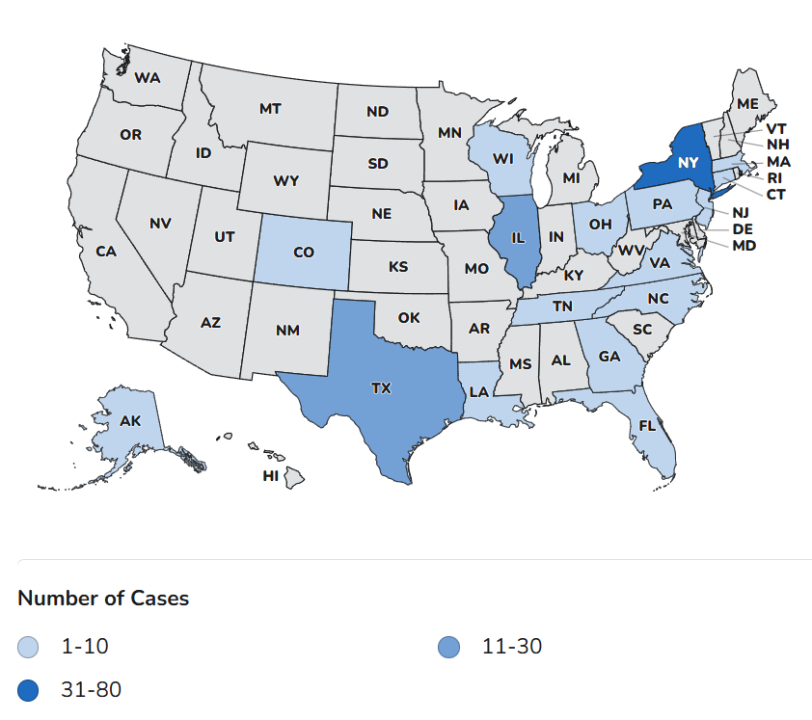
The ongoing expansion of the 2026 cyclosporiasis tracking season, which officially runs from May 1 through August 31, highlights a fundamental vulnerability in global industrial farming. Unlike bacterial contaminants such as E. coli or Salmonella, which can often be mitigated via standard chlorine washes or surface sanitizers, Cyclospora oocysts possess a highly resilient, thick structural wall.
This allows the microscopic parasite to survive long-term environmental exposure in agricultural runoff water and cling tightly to the complex, textured surfaces of raw produce, including fresh basil, cilantro, mesclun lettuces, and imported berries.
Because person-to-person transmission is virtually non-existent—as the parasite requires days to weeks outside the body to sporulate and become infectious—the presence of 145 distinct domestic cases points directly to systemic fecal-oral contamination vectors at the farm or packing facility level.
The clinical progression of the infection is notoriously prolonged if left untreated with the standard antibiotic regimen of trimethoprim-sulfamethoxazole (TMP-SMX).
Patients experience weeks of relapsing, watery diarrhea, severe abdominal cramping, explosive bowel movements, and significant weight loss, mimicking chronic inflammatory bowel syndromes and severely straining local outpatient diagnostic facilities.
Rational Analysis of Global Leadership Governance
From a grounded and realistic perspective, the multi-state cyclosporiasis surge demonstrates that modern food security requires more than passive retail inspections.
When a resilient parasite can slip through industrial wash cycles and disperse across 17 states simultaneously, it reveals a profound lack of oversight at primary agricultural water sources and harvesting centers. Relying on consumers to carefully wash raw produce is a superficial defense against structural biosecurity failures.
The path forward demands a rational commitment to upgrading real-time genomic surveillance and mandatory water-quality monitoring protocols across all cross-border agricultural operations. Global leadership governance must enforce strict, legally binding sanitary standards that protect international supply chains from environmental contamination.
For major global transit hubs like Egypt, which continuously expand agricultural exports, implementing advanced molecular-level tracking tools is essential for maintaining market access and ensuring absolute alignment with international sanitary regulations.
True consumer safety will not be achieved through temporary food recalls, but through the permanent, systematic enforcement of structural clean-water mandates at the very origin of global food production.
Journalistic Field Note: Epidemiological field data confirms that Cyclospora oocysts are highly resistant to standard chemical sanitizers, meaning that the only definitive methods for neutralizing the parasite within commercial food streams remain thorough cooking or absolute source-water purification.
Castle Journal Ltd
British company for newspapers and magazines publishing
London-UK – licensed 10675
Founder | Owner| CEO
Abeer Almadawy
Abeer Almadawy is a philosopher who established the third mind theory research and the philosophy of non-self and trans egoism. She is also the author of the New Global Constitution for the leadership Governance 2030/2032. She has many books published in English, Arabic, Chinese, French and others.
Castle Journal newspapers are the only voice and the brain of the world leadership governance.

