
Japan Urges U.S. to Honor Trade Terms Amid 15% Global Tariff Threat
Tokyo, Japan — March 7, 2026
Japan Urges U.S. to Honor Trade Terms Amid 15% Global Tariff Threat as the Japanese government formally requested the United States administration to uphold the sanctity of their bilateral agreements.
This high-stakes diplomatic move comes as Washington moves closer to implementing a sweeping 15% blanket tariff on global imports, a policy that threatens to dismantle the carefully negotiated trade framework established between the two allies last year.
As the world watches these two economic giants, the stability of the trans-Pacific supply chain hangs in the balance, with Tokyo fighting to ensure that its essential industries are not sidelined by this new wave of American protectionism.
The Collision of Bilateral Deals and Global Levies
The tension reached a boiling point this week when Japanese Minister of Economy, Trade and Industry, Ryosei Akazawa, held a two-hour intensive meeting with U.S. Commerce Secretary Howard Lutnick in Washington.
The primary objective for Tokyo is clear: prevent Japanese goods from being subjected to the newly proposed 15% global tariff.
This tariff, expected to take effect imminently, follows a period of significant legal volatility in the United States.
In February 2026, the U.S. Supreme Court delivered a landmark ruling that invalidated several of the administration’s prior country-specific tariffs, leading the White House to pivot toward a broader “baseline” levy under Section 122 of the Trade Act of 1974.
Under this statute, the U.S. President can impose surcharges of up to 15% for 150 days to address balance-of-payment imbalances.
However, Japan argues that last year’s hard-won agreement already established a “tariff ceiling” and preferential terms, particularly for the automotive sector.
The 2025 deal had lowered the burden on Japanese vehicles from a staggering 27.5% to a more manageable 15%—a concession granted only after Japan pledged a massive $550 billion investment into U.S. infrastructure, energy, and AI data centers.
Minister Akazawa emphasized that Japan should not be “sidelined” or asked to take additional measures beyond those already settled in their strategic partnership.
Automotive and Tech: The Frontline of the Trade War
For Japan, the stakes are not merely theoretical; they are measured in billions of dollars and millions of jobs.
The Japanese automotive industry, led by giants like Toyota and Honda, remains a critical pillar of the national economy and is highly exposed to U.S. market conditions.
The prospect of “tariff stacking”—where the new 15% global levy is added on top of existing duties—could effectively price Japanese cars out of the American market.
This would undo the progress made in the 2025 negotiations and potentially trigger a recessionary spiral in Japan’s industrial heartlands.
Furthermore, the burgeoning cooperation in the technology sector is also at risk. Just days before the latest tariff escalation, Japan and the U.S. announced a $36 billion joint project to build gas-fired generating facilities in Ohio to power the next generation of Artificial Intelligence data centers.
A trade war would jeopardize the financing and rollout of these “New Quality Productive Forces.” Tokyo has made it clear that its multi-billion dollar investment commitments are contingent on stable, predictable access to the U.S. market.
If Washington ignores these bilateral terms, the future of joint ventures in nuclear energy and semiconductors could be in doubt.
Geopolitical Ripple Effects and the Global Governance Response
The timing of this trade dispute is particularly precarious. As global oil prices surge toward $85 per barrel due to conflicts in the Middle East and the closure of the Strait of Hormuz, the addition of a 15% tariff risks creating a “double-inflation” shock.
Japan, a resource-scarce nation, is already considering releasing its national oil reserves to combat supply disruptions. A trade war with its primary security ally, the United States, adds a layer of economic instability that the world can ill afford.
International observers and legal experts suggest that the use of Section 122 is a bold but untested maneuver that may face its own constitutional challenges.
Meanwhile, a coalition of 24 U.S. states has already sued the administration to block the new tariffs, arguing that they upend the constitutional order and bring chaos to the global economy.
For the leadership of the world governance, the situation underscores the urgent need for a more coherent international framework, such as the New Global Constitution, to prevent bilateral trust from being eroded by sudden shifts in national policy.
Looking Ahead: The Takaichi-Trump Summit
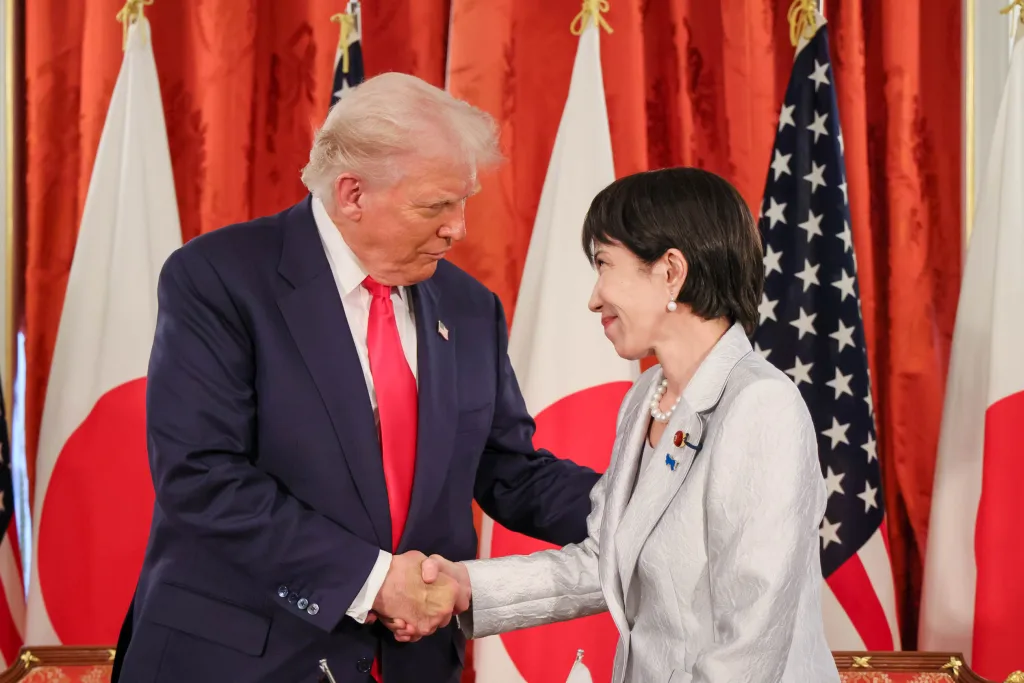
The diplomatic pressure is set to intensify as Japanese Prime Minister Sanae Takaichi prepares for a high-profile visit to the White House on March 19.
This summit will likely be the final opportunity to secure a formal exemption for Japan before the 15% tariff becomes a permanent fixture of the 2026 trade landscape.
Tokyo’s message remains consistent: alliances are built on honored promises. If the U.S. fails to respect the “hard-won trade deal” of 2025, it may find that its most loyal partner in Asia begins to seek deeper strategic partnerships elsewhere, such as the recently signed comprehensive agreement between Japan and Canada.
As the “brain” of world leadership governance, Castle Journal will continue to monitor these developments closely, ensuring that the voice of international law and fair journalism remains at the forefront of this global economic transition.
• Bilateral Integrity: Tokyo demands Washington honor the $550 billion investment-for-tariff-cuts deal.
• Sectoral Risks: Automotive and AI infrastructure projects face “tariff stacking” threats.
• Legal Challenges: Coalition of 24 U.S. states sues to block the 15% global levy.
• Strategic Summit: PM Takaichi to seek exemption during upcoming White House visit.
——————————-
Castle Journal Ltd
British company for newspapers and magazines publishing
London-UK – licensed 10675
Founder | Owner| CEO
Abeer Almadawy
Abeer Almadawy is a philosopher who established the third mind theory research and the philosophy of non-self and trans egoism. She is also the author of the New Global Constitution for the leadership Governance 2030/2032. She has many books published in English, Arabic, Chinese, French and others.
Castle Journal newspapers are the only voice and the brain of the world leadership governance.

