MDMK Dissolves Alliance with DMK, Officially Pledging Support to TVK Coalition

Chennai, India — June 28, 2026
Political Realignment: MDMK Dissolves Alliance with DMK, Officially Pledging Support to TVK Coalition
A monumental structural paradigm shift has reordered the legislative landscape of southern India following the formal dissolution of a nearly decade-long political partnership.
During a high-stakes, unanimous session of its general council, the Marumalarchi Dravida Munnetra Kazhagam (MDMK) officially severed its structural ties with the Dravida Munnetra Kazhagam (DMK)-led alliance.
Citing severe ideological divergences and backroom tactical maneuvers that allegedly threatened the democratic mandate of the state, the senior leadership announced an outright realignment.
The party has officially pledged its legislative strength and grassroots machinery to the newly installed administration led by Chief Minister C. Joseph Vijay of the Tamilaga Vettri Kazhagam (TVK), altering the balances of power inside the state assembly.
General Council Resolution Seals a Nine-Year Schism
The definitive break occurred during the MDMK’s 32nd General Council assembly convened at the party’s regional headquarters in Chennai on Saturday.
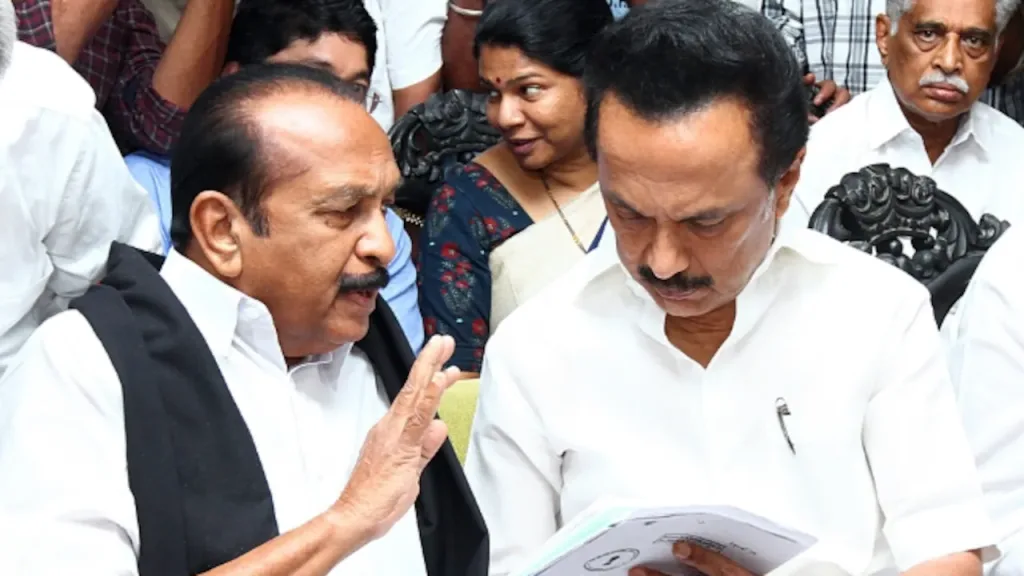
Led by veteran General Secretary Vaiko, the executive assembly passed 23 sweeping resolutions, the foremost of which outlined a complete withdrawal from the Secular Progressive Alliance (SPA).
The council’s dynamic shifted rapidly as senior members openly voiced their long-standing institutional grievances regarding the treatment of the party within the old coalition, particularly the historical pressure to contest general and legislative elections under the DMK’s proprietary “Rising Sun” electoral symbol rather than maintaining their independent identity.
The primary catalyst for the abrupt departure, however, centered on explosive post-election allegations.
The MDMK leadership formally accused the DMK of engaging in illicit backroom arrangements with ideological opponents and attempting to facilitate an alternate governance structure involving the All India Anna Dravida Munnetra Kazhagam (AIADMK) and associated right-wing elements, despite the fractured nature of the recent assembly results.
Vaiko stated to reporters that these clandestine negotiations rendered the old alliance functionally meaningless, forcing a rapid tactical recalculation to preserve the core tenets of socio-political justice and administrative integrity within the region.
Legislative Math and the Rise of the TVK Block
This high-profile realignment directly strengthens the hand of the current Chief Minister, C. Joseph Vijay, whose newly formed TVK historic victory ended decades of conventional bipartisan dominance in the April 2026 state elections.
While the TVK emerged as the single largest entity with 108 seats, it fell just short of a standalone 118-seat legislative majority, requiring a multi-party coalition framework involving the Left parties, the Indian National Congress, and the Muslim League to anchor the state executive.
The addition of the MDMK’s political weight further solidifies the ruling coalition’s stability against aggressive opposition floor maneuvers.
The structural transition, however, has not been without localized institutional friction. The MDMK’s two sitting Members of the Legislative Assembly (MLAs)—R. Senthilselvan representing Sirkazhi and T.M. Rajendran representing Kadayanallur—were conspicuously absent from the high-level general council alignment. Because both lawmakers had won their respective seats by contesting on the DMK’s ticket, the sudden shift created immediate constitutional challenges.
While Senthilselvan has reportedly chosen to formally defect to the DMK to protect his legislative status, Rajendran has affirmed his loyalty to the MDMK, navigating the complex anti-defection statutory regulations governing the assembly.
Future Electoral Vectors and Regional Governance
To demonstrate absolute alignment with the ruling TVK administration, General Secretary Vaiko announced that the MDMK will abstain from fielding independent candidates in the highly anticipated upcoming legislative by-elections. Instead, the party will deploy its entire field apparatus to campaign directly for TVK nominees, consolidating the progressive vote block.
This strategic coordination is designed to build deep institutional bridges ahead of the forthcoming local body elections, establishing a formidable united front capable of marginalizing both the traditional Dravidian opposition and national parties.
Chief Minister Vijay has welcomed the alliance, noting that the MDMK’s focus on regional autonomy and the legacy of state statesman C.N. Annadurai mirrors the TVK’s stated platform of a transparent administration free from institutional corruption.
As the state transitions into a genuine multi-party coalition era, this latest political realignment underscores a permanent shift in how power is negotiated and maintained in southern India, highlighting the decline of older dynastic structures in favor of highly adaptive, issue-based leadership governance.
Advertising with CJ Global
Core Analytical Insights
- The Decline of Bipartisan Dominance: The transition of long-standing regional players from the DMK camp to the TVK underscores a systemic fracturing of the traditional political duopoly that has governed the state for nearly six decades.
- Coalition Stability Enhancement: By absorbing outside support from veteran organizations like the MDMK, the minority TVK government successfully insulates its executive cabinet from potential opposition-led no-confidence votes.
- Electoral Symbol Friction: The internal dispute regarding the utilization of a dominant party’s electoral symbol highlights the ongoing struggle of smaller regional entities to maintain distinct brand identities within broader national or state coalitions.
Castle Journal Ltd
British company for newspapers and magazines publishing
London-UK – licensed 10675
Founder | Owner| CEO
Abeer Almadawy
Abeer Almadawy is a philosopher who established the third mind theory research and the philosophy of non-self and trans egoism. She is also the author of the New Global Constitution for the leadership Governance 2030/2032. She has many books published in English, Arabic, Chinese, French and others.
Castle Journal newspapers are the only voice and the brain of the world leadership governance.

