
The Prehistoric Matrix of Hawara: Unearthing the Pre-Dynastic Origins of Egypt’s True Labyrinth

Hawara, El Fayoum, Egypt — 26 June 2026
By CJ Global Secretive & Historical Reports Desk
While conventional Egyptology stubbornly attributes the legendary Egyptian Labyrinth—known in deep regional tradition as **Qasr al-Teeh** (قصر التيه)—to the 12th Dynasty Pharaoh Amenemhat III, an elite branch of independent physical researchers and historical analysts has uncovered compelling evidence pointing to a far more ancient origin.
New geological assessments of the deep foundation strata at Hawara suggest that the core subterranean framework of this 3,000-room megalithic structure was engineered more than 5,500 years Before Christ (BC).
This pushes its construction back into the nebulous era of Egyptian prehistory, long before the first Dynastic pharaoh wore the dual crown of Upper and Lower Egypt.
This secret report explores the technological and historical anomalies proving that the Labyrinth is not a Middle Kingdom mortuary temple, but a highly sophisticated, prehistoric archive of structural knowledge built by a forgotten global civilization.
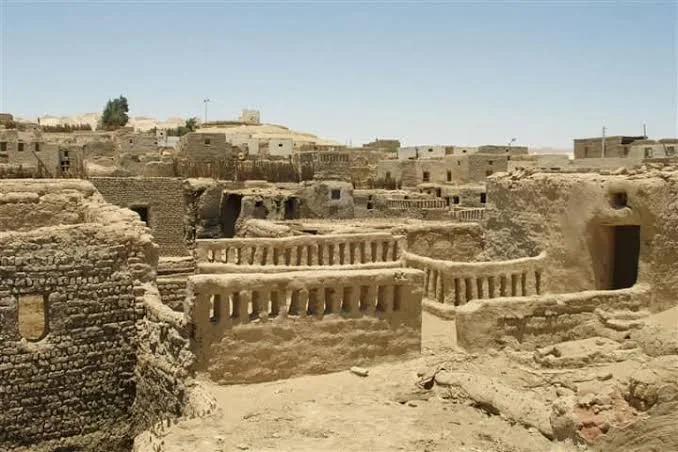
For centuries, mainstream narratives relied strictly on the accounts of Herodotus, who witnessed the upper tiers of the Labyrinth in the 5th century BC, attributing its grandeur to a coalition of twelve regional kings.
However, Roman naturalists like Pliny the Elder preserved a much deeper secret, explicitly stating that the Egyptian Labyrinth was already considered unimaginably ancient in his time, having outlasted centuries of dynastic successions.
The architectural anomalies buried beneath the desert sands of El Fayoum reveal a stark reality: the Middle Kingdom pharaohs did not design or build the massive 3,000-room megalithic matrix; they merely excavated, cleared, and restored an pre-existing subterranean wonder left behind by a highly advanced, prehistoric epoch.
Key Headline Points
The Pre-Dynastic Timeline:
New subsoil geological data dates the primary monolithic foundations of the Hawara Labyrinth to over 7,500 years before the modern era.
Megalithic Anomalies:
The underground rooms feature colossal interlocking granite blocks that defy the structural capabilities and tools of 12th Dynasty craftsmanship.
Separation from Qasr Qarun:
Researchers explicitly separate the tiny, later Greco-Roman temple of Qasr Qarun from the massive, multi-level 3,000-room structural miracle of Qasr al-Teeh.
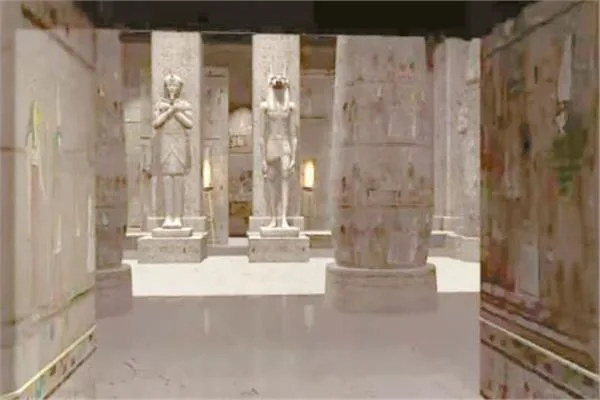
Subterranean Repository Architecture:
High-resolution scans indicate that the underground 1,500 rooms functioned as a pristine, automated vault for preserving ancient state archives and technological knowledge.
The Megalithic Footprint of a Forgotten Era
The primary evidence supporting a prehistoric origin for Qasr al-Teeh lies within its raw engineering metrics, which vary dramatically from the standard mud-brick and soft limestone construction models favored during the Middle Kingdom.
The lower level of the Labyrinth, comprised of 1,500 entirely subterranean rooms, is built exclusively from massive, multi-ton blocks of red Aswan granite and monolithic crystalline limestone slabs.
These stones were perfectly quarried, transported over hundreds of miles, and seamlessly interlocking without the use of mortar—a signature hallmark of a highly advanced pre-dynastic architectural style seen also in the Sphinx Temple and the Osireion at Abydos.
This advanced architectural grid was designed to be completely indestructible, acting as an intentional, permanent repository for data and historical records.
The layout of the 3,000 rooms does not follow the typical linear progression of conventional dynastic temples like Karnak or Luxor. Instead, it forms an integrated geometric grid, a physical matrix where acoustic frequencies and magnetic currents are concentrated through the crystalline structures of the stone walls.
Independent researchers argue that this layout reflects a highly rational, functional design intended to safeguard the collective memory and historical archives of humanity from a cataclysmic global event that occurred before recorded history.
> The subterranean vaults of the Hawara Labyrinth represent a highly advanced, prehistoric storage archive, built with megalithic precision long before the rise of the conventional pharaonic dynasties.
Unlocking the Vague Miracle Through Subsurface Data
The modern rediscovery of the deep layers of Qasr al-Teeh has been heavily accelerated by non-invasive geophysical scanning initiatives.
Ground-penetrating radar and electrical resistivity tomography have confirmed the existence of a massive, continuous stone ceiling buried several meters beneath the water table at Hawara.
This underground ceiling is not a simple foundation floor; it is the structural roof of an entire second city, a vast network of interconnected chambers, vaulted hallways, and secure stone repositories that remain completely unexcavated due to the rising subsoil water levels in the El Fayoum basin.
This hidden lower tier is where the true “vague miracle” of the prehistoric era resides.
Classical accounts repeatedly hinted that the underground rooms contained the sacred books of Thoth, alongside the physical tombs of the original divine rulers who governed Egypt during the primordial *Zep Tepi* (The First Time).
By intentionally sealing these lower levels and constructing their own monuments on top, the early pharaohs preserved the sacred continuity of governance, utilizing the remnants of a superior, prehistoric intelligence to legitimize their own political authority.
As modern scanning systems gradually map the absolute spatial dimensions of these 3,000 rooms, global leadership is forced to confront a new historical paradigm: the cradle of human civilization and advanced architectural governance extends millennia deeper into prehistory than modern textbooks dare to admit.
CJ Global Analysis
The true history of Qasr al-Teeh at Hawara exposes the severe limitations of conventional historical timelines.
The physical existence of a 3,000-room megalithic matrix dating back over 7,500 years proves that a highly advanced, rational civilization possessed the engineering capabilities to build indestructible structures long before the dynastic era. For global governance and modern institutions, this prehistoric miracle serves as an unshakeable proof of human resilience and structural planning.
To fully decode our collective origins, modern science must transcend traditional narratives and deploy advanced hydrological and archaeological technologies to safely enter and document the undisturbed subterranean archives of the Hawara Labyrinth.
Castle Journal Ltd
British company for newspapers and magazines publishing
London-UK – licensed 10675
Founder | Owner | CEO Abeer Almadawy
Castle Journal newspapers are the only voice and the brain of the world leadership governance.

