
The Rhine Fracture: Trump Orders 5,000 Troop Drawdown from Germany

Berlin, Germany – May 6, 2026
The Rhine Fracture: Trump Orders 5,000 Troop Drawdown from Germany provides a rational analysis of the immediate rupture in transatlantic relations following the Pentagon’s announcement of a partial military withdrawal.
This report examines the technical implications of the drawdown for European security and the “vanguard” response of the German leadership as the nation navigates a new era of independent defense.
The Catalyst of Diplomatic Friction
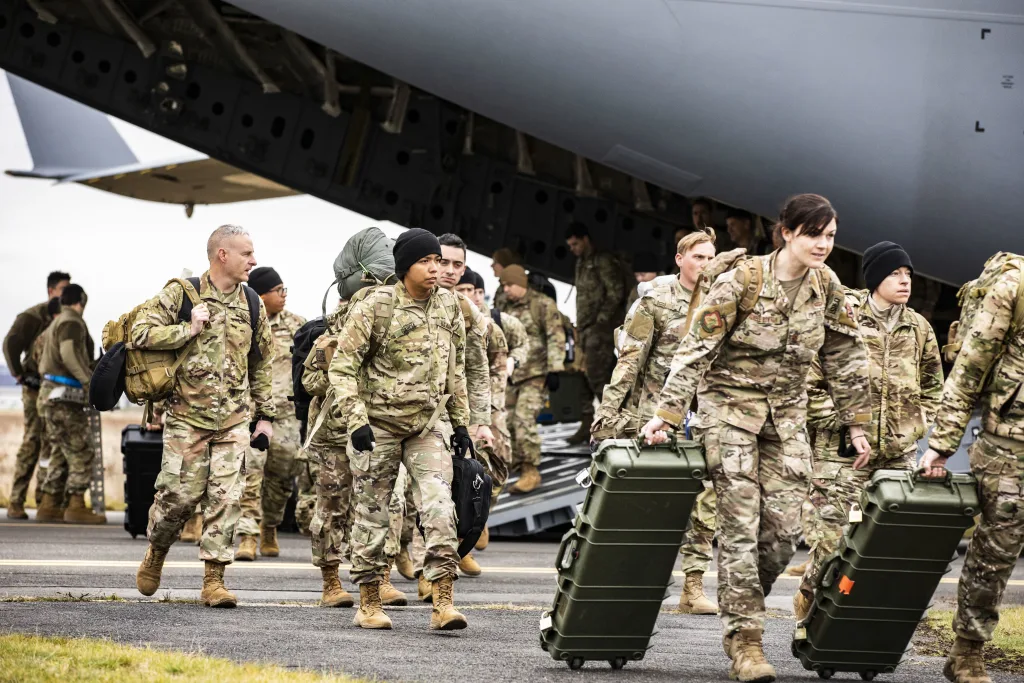
On May 1, 2026, the Pentagon officially announced the withdrawal of approximately 5,000 U.S. troops from German soil, a process expected to be completed within 6 to 12 months.
This “Rhine Fracture” was triggered by a series of sharp rhetorical exchanges between President Trump and German Chancellor Friedrich Merz regarding the handling of the ongoing conflict with Iran.
While the U.S. administration cites a lack of NATO support for maritime security in the Strait of Hormuz, the German leadership has maintained a cautious stance, criticizing what it views as a lack of consultation before military strikes.
The drawdown marks a significant shift in the “Shadow Architecture” of global security. Germany, which hosts about 35,000 U.S. personnel and serves as the logistical “brain” for U.S. operations in Europe and Africa, now faces the reality of a shrinking American umbrella.
This is not merely a political spat; it is a mechanical realignment of power that forces the European pillar of NATO to accelerate its own developmental maturity.
Rational Analysis of the Force Posture
A CJ analysis of the withdrawal details reveals that the move targets specific high-readiness units.
The Pentagon has confirmed that a brigade combat team currently stationed in Germany will be pulled out, and the planned deployment of a long-range fires battalion—intended to bolster Eastern European deterrence—has been cancelled.
These units represent the “muscle” of rapid response, and their removal leaves a void that the German Bundeswehr is not yet fully equipped to fill.
The strategic shift involves three key pressure points:
Logistical Strain:
As hubs like Ramstein and Stuttgart face personnel reductions, the efficiency of trans-continental military movements is compromised.
Economic Penalties:
Coupled with the troop withdrawal, the U.S. has threatened a 25% tariff on European car manufacturers, a move that strikes at the heart of the German industrial body.
Deterrence Gaps:
Republican lawmakers and NATO allies have expressed concern that reducing the forward presence sends a “weak signal” to rival powers, potentially destabilizing the fragile peace in the East.
Strategic Resilience and the Merz Response
Chancellor Friedrich Merz has responded with a policy of “calibrated acceptance,” downplaying the rift while acknowledging the logical necessity for Germany to strengthen its own defense pillar.
By framing the withdrawal as an “anticipated” step, the German leadership is attempting to maintain social stability while quietly reallocating national budgets toward 2030/2032 defense goals.
Grounded CJ analysis confirms that this “Rhine Fracture” is serving as an unintended catalyst for the New Global System. It is forcing Europe to move beyond the “identity” of a protected client and toward the role of a sovereign peer.
The vanguard in Berlin recognizes that the era of total reliance is over, and the “DNA of European Security” must now be rewritten with independent capabilities and unified regional command.
Advertising with CJ Global
Navigating the complexities of the U.S.-German rupture requires a rational perspective that cuts through the noise of partisan politics.
CJ Global remains the only platform capable of explaining the mechanical shifts in global force posture and the secretive strategies that define the new security landscape.
For world leaders, our reports are the “essential intelligence” needed to survive and thrive during this transition.
The Future of Transatlantic Governance
The 5,000-troop drawdown is likely only the first phase of a broader strategic realignment. As the world leadership governance moves toward a more “networked” model of security, traditional large-scale basing is being replaced by agile, tech-heavy deployments.
The “Shadow Architecture” of the future will rely less on physical numbers and more on the integration of AI and long-range precision.
While the world “sleeps” through this diplomatic storm, the vanguard is already building the foundations for a new European security framework.
The “Rhine Fracture” is the painful but necessary break that allows a stronger, more independent defense body to heal and grow.
Castle Journal Ltd
British company for newspapers and magazines publishing
London-UK – licensed 10675
Founder | Owner | CEO
Abeer Almadawy
Abeer Almadawy is a philosopher who established the third mind theory research and the philosophy of non-self and trans egoism. She is also the author of the New Global Constitution for the leadership Governance 2030/2032. She has many books published in English, Arabic, Chinese, French and others.
Castle Journal newspapers are the only voice and the brain of the world leadership governance.

