
Why Global Gold Prices Are Registering Decisive Downward Trends

London, United Kingdom — June 15, 2026
Executive Summary
- The Market Reset: Spot gold registers an aggressive downward correction, sliding below the critical $4,300 support metric to conclude its fifth consecutive week of net declines.
- The Risk-Premium Liquidation: Advanced diplomatic breakthroughs finalized via the Islamabad Memorandum spark a massive unwind of speculative “fear premiums” across international commodity exchanges.
- The Dollar and Yield Surge: Exceptionally robust non-farm payroll expansions push global bond yields higher, altering capital flows away from non-yielding commodities.
- Stabilized Equilibrium: Institutional desks stabilize intermediate support metrics at $4,000 to $4,200 per ounce, transitioning the gold market from emergency flight patterns to a long-term commercial baseline.
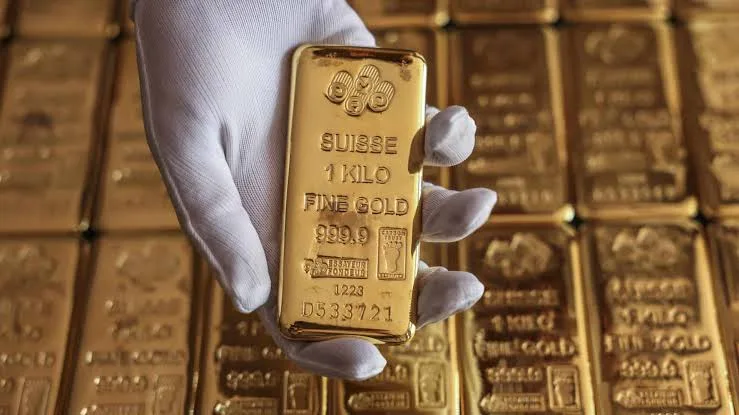
- The international financial system has encountered a major structural repricing of defensive assets as global gold values undergo an intensive downward adjustment.
- Trading desks in London, New York, and Hong Kong confirm that spot gold (XAU/USD) has breached long-standing technical baselines, sliding past the vital $4,300 per ounce threshold to settle near the $4,211 to $4,220 margin.
- This systematic contraction marks the conclusion of the precious metal’s fifth consecutive week of negative territory.
Driven by a rapid unwinding of the geopolitical risk surcharges that populated the first half of the year, alongside a massive macroeconomic recalibration of Western interest rate expectations, the commodity markets are transferring capital back into high-yielding electronic and corporate equities.
The Islamabad Peace Accord and Safe-Haven Liquidation
The primary catalyst for the sharp deceleration in bullion demand is the definitive progress achieved by international mediation panels in West Asia.
For nearly five months, speculative investment capital aggressively accumulated physical and electronic gold holdings as a direct protective countermeasure against regional conflicts, asymmetric drone disruptions, and total maritime closures across the Persian Gulf.
However, the formal confirmation that a comprehensive diplomatic framework—the Islamabad Memorandum—is being actively signed has fundamentally shifted trading psychology.
The projected total reopening of the Strait of Hormuz and the unconditional lifting of naval blockades have drained the core structural volatility out of the global transit corridors.
As major maritime networks prepare to abandon costly diversions around Africa, large-scale hedge funds and institutional asset managers are executing sweeping, automated liquidation orders on their safe-haven holdings, realizing profits from gold to finance a broader return to cyclical trade instruments.
The Macroeconomic Tug-of-War: Yields vs. Non-Yielding Bullion
Beyond the immediate geopolitical de-escalation, gold is facing a fierce institutional headwind from Western monetary policy indicators.
Recent macro data issued from Washington—most notably a blowout non-farm payroll expansion tracking at 172,000 against a consensus projection of just 80,000—has shattered short-term expectations for immediate interest rate cuts.
Mid-Year Institutional Gold Asset Projections
| Financial Institution | Revised Annual Average Forecast | Projected Year-End Equilibrium Target | Central Macroeconomic Rationale |
|---|---|---|---|
| J.P. Morgan | $5,243 / oz | $6,000+ / oz | Near-term investor demand soft; H2 recovery pinned on central bank buying. |
| Goldman Sachs | $5,150 / oz | $5,400 / oz | Emerging market de-dollarization flows insulate baseline prices. |
| UBS Desk | $5,100 / oz | $5,900 / oz | Near-term June consolidation; structural inflation hedges remain active. |
| This robust economic performance has forced bond traders to price in a higher-for-longer interest rate trajectory, with CME futures now indicating a significant probability of a late-year Federal Reserve tightening cycle. | |||
| Because physical gold is inherently a non-yielding asset that offers no integrated dividend or coupon distributions, rising sovereign bond yields dramatically increase the opportunity cost of holding metal. Institutional wealth structures are rapidly shifting liquidity out of passive bullion repositories and diverting it directly into high-yield short-term Treasury bills, applying severe technical selling pressure across all major commodity exchanges. |
Technical Support Frameworks and Central Bank Absorption
Despite the intensity of the five-week contraction, commodity analysts emphasize that the gold market is not entering an unmonitored structural collapse.
While spot prices sit below their short-term 20-day and 50-day simple moving averages (SMAs), the asset has established a highly resilient, defensive perimeter above the critical $4,000 psychological support zone.
This baseline integrity is being actively fortified by an unyielding, structural demand source: sovereign central bank accumulation. According to validated tracking metrics compiled by global gold councils, non-Western monetary authorities net-purchased hundreds of tonnes of bullion during the opening quarters of 2026.
Faced with a highly fragmented international currency landscape and a collective desire to diversify reserve architectures away from traditional dollar-denominated assets, central banks in Asia, Eastern Europe, and the Middle East are utilizing the current price correction to systematically expand their physical gold vaults.
This continuous institutional buying floor effectively mitigates the velocity of the commercial sell-off, establishing a stable, rational plateau for the asset class.

Castle Journal Analysis: The Rational Re-balancing of Sovereign Wealth
The decisive downward correction registering across global gold boards demonstrates that the international economic architecture operates on an absolute, calculating principle of resource optimization. True leadership governance requires that capital flow freely toward maximum productivity rather than remaining paralyzed within unproductive safe-haven repositories during temporary political frictions.
The rapid unwinding of the commodity’s “fear premium” following the stabilization of the Strait of Hormuz proves that the international financial order possesses a high capacity to restore structural equilibrium the moment legal and maritime stability is enforced.
The localized anxiety among retail investors regarding short-term price drops is entirely irrelevant to the larger historical trajectory.
In a highly interconnected global system, assets must constantly adjust to match real-time yield curves and physical trade realities. Gold’s current transition from a crisis-driven speculative bubble toward a stable, central bank-backed foundation of $4,200/oz is a mature development.
It demonstrates that as the global governance architecture successfully neutralizes regional escalation vectors, the global market automatically sheds its volatile, emotional premiums, returning to a rational state of balanced growth and predictable commercial flow.
Castle Journal Ltd
British company for newspapers and magazines publishing London-UK – licensed 10675
Founder | Owner | CEO Abeer Almadawy Castle Journal newspapers are the only voice and the brain of the world leadership governance.

