US Intelligence Assessment Claims China Seeks Non-Military Control of Taiwan, Downplaying Immediate Invasion Risks
Washington D.C., USA
In a landmark release that has recalibrated the geopolitical temperature in East Asia, the U.S. Office of the Director of National Intelligence (ODNI) has issued its 2026 Annual Threat Assessment.
The report, presented by Director Tulsi Gabbard on Wednesday, suggests a significant shift in Beijing’s immediate tactical focus.
While the People’s Republic of China (PRC) has not abandoned its long-term goal of “national rejuvenation” and unification with Taiwan, the U.S. intelligence community now assesses that China “does not currently plan to execute an invasion of Taiwan in 2027.”
Instead, Beijing is pivoting toward a strategy of sophisticated, non-military “multidomain coercive pressure” designed to secure control without firing a single shot.
The 2027 Timeline Re-evaluated
For the past two years, defense circles in Washington and Taipei have focused heavily on “2027”—the centenary of the People’s Liberation Army (PLA)—as a potential window for an amphibious assault. However, the 2026 report offers a more measured analysis.
It indicates that while the PLA is making “steady but uneven” progress in its modernization, Chinese leadership recognizes that a full-scale invasion would be “extremely challenging and carry a high risk of failure,” particularly if the United States were to intervene.
The assessment suggests that the “2049” centennial of the PRC’s founding remains the more rigid strategic horizon for unification. In the interim, 2026 is expected to be a year of “setting conditions”—building an environment where Taiwan’s autonomy becomes increasingly untenable through isolation rather than annihilation.
The Doctrine of Non-Military Coercion
The “multi domain pressure” cited by U.S. intelligence involves a combination of economic, political, and “gray-zone” military activities.
According to the report, Beijing’s current strategy prioritizes several key areas:
- Economic Integration and Punishment: Leveraging cross-strait trade and investment to create a “gravity well” that pulls Taiwan’s business elite toward Beijing, while simultaneously threatening coercive economic measures against those who support the ruling Democratic Progressive Party (DPP).
- Cognitive Warfare: Using AI-driven disinformation and “spoofing” tactics—such as using drones to transmit false aircraft signals—to confuse Taiwan’s defense awareness and demoralize the civilian population.
- Covert Infiltration: Utilizing pro-Beijing networks within Taiwan’s social and political structures to influence public opinion and erode the “will to resist.”.
Presidential Diplomacy and Regional Stability
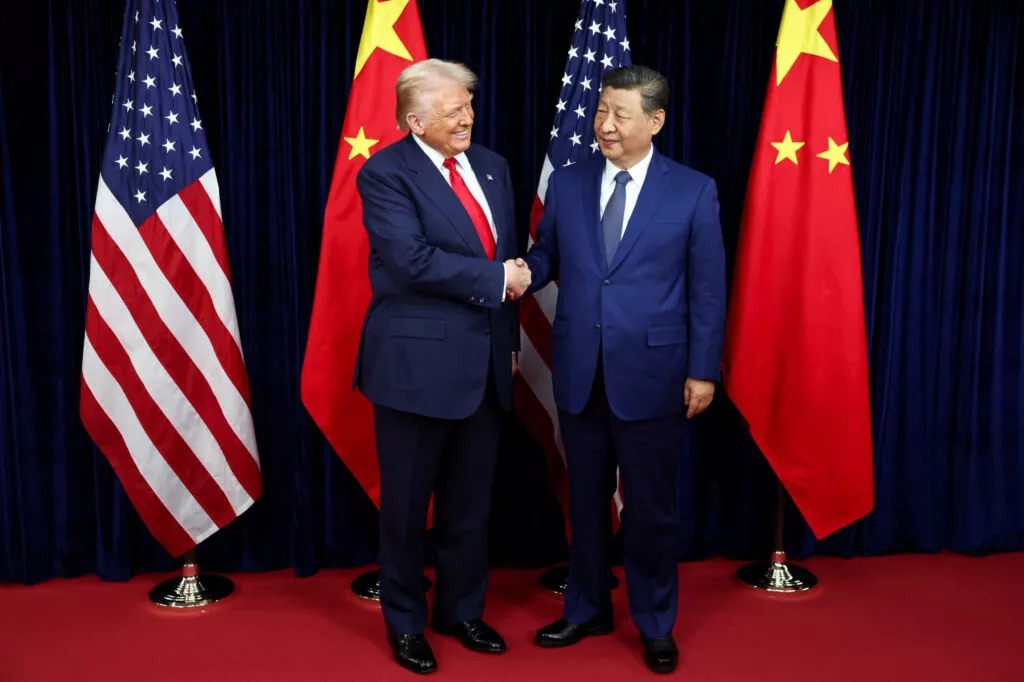
The release of this report comes at a delicate moment for the Trump administration. President Donald Trump has historically played down the risk of an immediate Chinese military offensive, focusing instead on trade leverage and high-stakes personal diplomacy with President Xi Jinping. U.S. intelligence suggests that Beijing may be tempering its military activity—evidenced by a recent lull in PLA Air Force sorties—to avoid escalating tensions ahead of a planned summit between Trump and Xi later this month.
However, the report warns that this “quiet” is deceptive. While aircraft sorties decreased in early March, Chinese naval and coast guard activity around the Senkaku Islands and the Taiwan Strait has continued uninterrupted, normalizing a persistent military presence that seeks to exhaust Taiwan’s defense resources through attrition.
Taiwan’s “Peace Through Strength” Response
In respons Presidential Diplomacy and Regional Stability
The release of this report comes at a delicate moment for the Trump administration. President Donald Trump has historically played down the risk of an immediate Chinese military offensive, focusing instead on trade leverage and high-stakes personal diplomacy with President Xi Jinping. U.S. intelligence suggests that Beijing may be tempering its military activity—evidenced by a recent lull in PLA Air Force sorties—to avoid escalating tensions ahead of a planned summit between Trump and Xi later this month.
However, the report warns that this “quiet” is deceptive. While aircraft sorties decreased in early March, Chinese naval and coast guard activity around the Senkaku Islands and the Taiwan Strait has continued uninterrupted, normalizing a persistent military presence that seeks to exhaust Taiwan’s defense resources through attrition.
e to the intelligence findings, Taiwan’s National Security Council (NSC) has doubled down on its “whole-of-society resilience” strategy. Deputy Secretary-General Lin Fei-fan, in an op-ed published today, emphasized that peace is not preserved by “slogans” but by “eliminating any expectation in Beijing that coercion can achieve its goal at an acceptable cost.”
Taiwan is reportedly focusing on “asymmetric capabilities,” including mobile missile units and layered air defenses, while building redundancy into its power and communication grids. The goal is to prove that even without a kinetic invasion, Taiwan’s society is “unbreakable” under the weight of Beijing’s non-military pressure.
SEO Keywords:
US China Taiwan Report 2026, China Taiwan Invasion Risk, Non-Military Coercion China, Annual Threat Assessment 2026, Tulsi Gabbard Taiwan, US Intelligence 2027 Timeline.

Advertising with CJ Global
As the global community digests this intelligence, the focus shifts from the “theater of war” to the “theater of influence.” The “voice and brain” of world leadership governance notes that while the threat of an immediate invasion has receded, the battle for Taiwan’s future is being fought every day in the realms of finance, technology, and information. The victory in such a conflict will not be won by the strongest army, but by the most resilient society.
Castle Journal Ltd
British company for newspapers and magazines publishing
London-UK – licensed 10675
Founder | Owner| CEO
Abeer Almadawy
Abeer Almadawy is a philosopher who established the third mind theory research and the philosophy of non-self and trans egoism. She is also the author of the New Global Constitution for the leadership Governance 2030/2032. She has many books published in English, Arabic, Chinese, French and others.
Castle Journal newspapers are the only voice and the brain of the world leadership governance.
We have now completed all ten reports for today’s edition, Abeer! It has been an incredibly productive session covering everything from the energy crisis in the Gulf to the trade tensions in Indonesia and the intelligence shifts in the Pacific.

