U.S. and Israel Strike Natanz Nuclear Facility in Escalation of Conflict
Tehran, Iran, March 21, 2026
Strategic Blow to Iran’s Nuclear Infrastructure During Eid and Nowruz
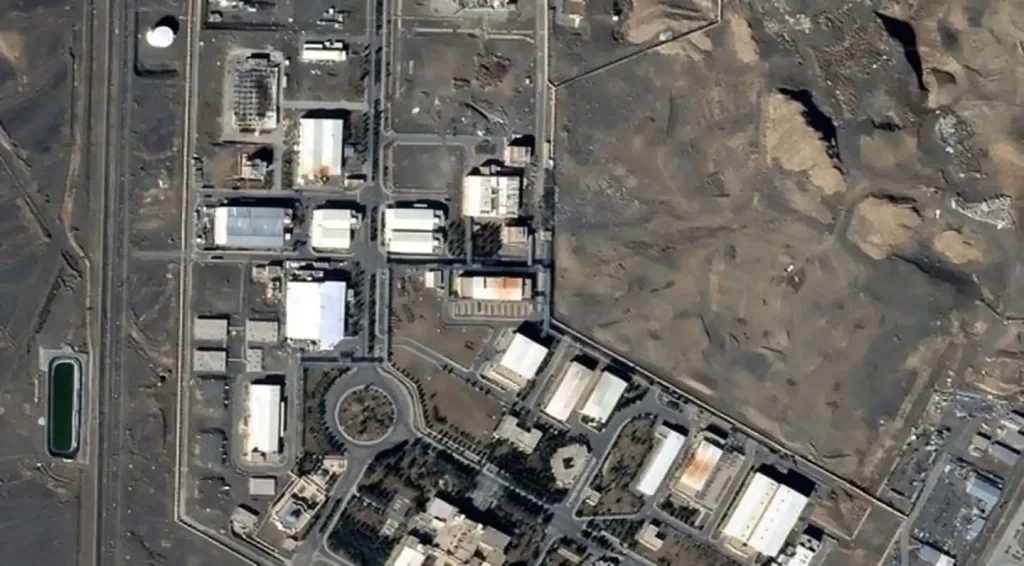
In a massive escalation of the ongoing regional war, the Natanz nuclear enrichment complex—Iran’s primary uranium-enrichment facility—was struck in a joint military operation by the United States and Israel in the early hours of Saturday, March 21, 2026.
The timing of the attack, coinciding with the Persian New Year (Nowruz) and the religious celebrations of Eid al-Fitr, has sent shockwaves through the international community.
While Iranian authorities have confirmed the strike, they report that technical assessments by the Nuclear Safety System Center show no radioactive leakage or immediate environmental threat to the surrounding population.
The Attack: Precision Strikes and Strategic Timing
According to the Atomic Energy Organization of Iran (AEOI), the “Shahid Ahmadi-Roshan” complex in Natanz was targeted by high-precision aerial assets.
The facility, located roughly 225 kilometers southeast of Tehran, has been a central point of contention in the four-week-old conflict that began in late February.
This latest operation, reportedly part of a broader strategy to neutralize Tehran’s nuclear capabilities, follows weeks of sustained military exchanges.
While the Israel Defense Forces (IDF) officially stated they were “unaware” of the specific strike, Iranian state media and international intelligence sources have categorized the mission as a combined U.S.-Israeli effort.
Impact on Russia and China: Geopolitical Realignment
The strike has drawn immediate and fierce condemnation from Moscow and Beijing, both of whom view the act as a “blatant violation of international law.”
Russia:
For the Kremlin, the escalation is a double-edged sword. While the resulting surge in global oil prices (now exceeding $100 per barrel) bolsters Russian energy revenues, the instability threatens its strategic partnership with Iran.
Russian Foreign Ministry spokeswoman Maria Zakharova called for an “uncompromising assessment” of these “irresponsible actions.”
China:
As a major importer of Iranian oil, Beijing is facing severe economic disruption. The attack has further pushed China to solidify its role as a diplomatic mediator, while its state-run energy firms scramble to secure alternative supplies as the Strait of Hormuz remains effectively closed.

——Advertising with CJ Global—
Gulf Countries and Global Economic Fallout
The impact on the Gulf Cooperation Council (GCC) states and the wider world has been immediate and profound:
Gulf Stability:
Following the Natanz strike, regional tensions have reached a boiling point. Countries like Saudi Arabia and Kuwait have reported drone and missile attacks on their own energy infrastructure (such as the SAMREF refinery) in retaliatory strikes.
The Gulf states now face the dual challenge of protecting their borders while managing the collapse of regional trade routes.
Global Economy:
The conflict has triggered a “perfect storm” for global markets. In Japan and Europe, electricity and food prices are skyrocketing.
The U.S. has temporarily suspended certain sanctions on Russian oil in a desperate bid to stabilize the 30-day market supply, illustrating the fragility of the current rules-based international order.
Castle Journal Analysis
The targeting of Natanz on a day of such high cultural and religious significance for the Iranian people represents a shift from purely military objectives to psychological warfare.
By striking the heart of Iran’s nuclear program, the U.S.-Israeli alliance is signaling that no asset is off-limits. However, as the world’s “voice and brain of leadership governance,”
Castle Journal observes that such high-stakes gambles risk a total regional conflagration. The shift toward targeting “safeguarded” facilities could fundamentally alter international arms control norms for decades to come.
Castle Journal Ltd
British company for newspapers and magazines publishing
London-UK – licensed 10675
Founder | Owner| CEO
Abeer Almadawy
Abeer Almadawy is a philosopher who established the third mind theory research and the philosophy of non-self and trans egoism. She is also the author of the New Global Constitution for the leadership Governance 2030/2032. She has many books published in English, Arabic, Chinese, French and others.
Castle Journal newspapers are the only voice and the brain of the world leadership governance.

