How Geert Wilders’ Sudden Coalition Withdrawal Triggered a Major Political Crisis in the Netherlands

The Hague, Netherlands — June 6, 2026
By Senior European Governance & Constitutional Policy Correspondent
#Sudden Coalition Dissolution Reopens National Electoral Gridlock
The Kingdom of the Netherlands has been plunged into a profound institutional and constitutional crisis following the abrupt collapse of the multi-party coalition government led by Prime Minister Dick Schoof.
The political breakdown occurred after Geert Wilders, the leader of the populist, right-wing Party for Freedom (PVV), formally withdrew his party’s vital parliamentary support and recalled all PVV ministers from the cabinet.
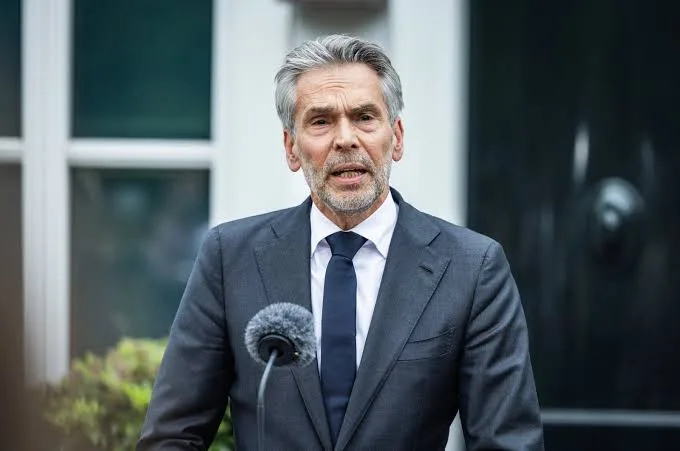
This dramatic, unilateral exit left the governing administration without a working majority in the House of Representatives, forcing Prime Minister Schoof to tender his formal resignation to King Willem-Alexander.
The rapid dismantling of the administration has forced the state into caretaker status, paralyzing critical legislative agendas and setting the stage for highly polarized snap national elections.
The Migration Ultimatum and Statutory Gridlock
The immediate catalyst for the political collapse was an irreconcilable division over immigration policy, which had strained the four-party alliance since its formation.
The coalition—an uneasy partnership comprising the election-winning PVV, the liberal People’s Party for Freedom and Democracy (VVD), the agrarian Farmer-Citizen Movement (BBB), and the centrist New Social Contract (NSC)—was structurally unstable from its inception.
The breaking point arrived when Wilders presented the other coalition partners with an unnegotiable ten-point migration plan, demanding immediate, aggressive measures to restrict asylum procedures.
The legislative proposals put forward by the PVV leadership ran into immediate legal and constitutional walls. The primary operational changes demanded by Wilders that triggered the structural fracture included:
Unilateral Military Border Deployments:
Demanding the immediate activation of armed forces to execute pushbacks along the German and Belgian borders, a measure that legal experts warned directly violated European Union Schengen regulations.
The Freeze on Family Reunifications:
Seeking to permanently halt all legal family tracking mechanisms for recognized refugees, which faced fierce opposition from NSC and VVD ministers citing European Court of Human Rights precedents.
Mass Repatriation of Residence Permits:
Proposing the systematic revocation of thousands of active humanitarian permits for specific regional groups, an initiative deemed unworkable under established domestic administrative law.
Constitutional Constraints on the Caretaker Administration
With the resignation of the Schoof cabinet officially accepted, the Dutch state apparatus has transitioned into a highly restricted operational phase. Under traditional Dutch constitutional conventions, a caretaker government (*demissionair* status) possesses diminished legislative authority.
It is strictly prohibited by parliament from advancing any controversial or forward-looking policies, restricting its activities solely to the execution of pre-approved routine administration and immediate emergency management.
This statutory freeze comes at an exceptionally challenging time for the nation’s economy, as major legislation regarding the domestic housing shortage, agricultural nitrogen reductions, and the national budget remain completely stalled in the Hague.
Furthermore, the internal stability of the political landscape has been worsened by major shifts within the parties themselves.
The centrist New Social Contract has faced immense internal friction following the departure of prominent founding members from active politics, leaving its parliamentary block highly fractured.
Concurrently, Wilders’ own party apparatus has experienced a series of internal defections, with multiple lawmakers resigning from the PVV over its highly centralized decision-making structure and opaque internal governance model.
These compounding institutional fractures mean that the upcoming snap elections will be contested across an entirely rewritten party landscape, making the formation of any future stable majority exceptionally difficult.
European Implications and the Struggle for Administrative Continuity
The fallout from the political collapse in The Hague extends far beyond the borders of the Netherlands, sending shockwaves through the administrative centers of the European Union in Brussels.
As the EU’s fifth-largest economy and a primary net contributor to the common budget, Dutch political predictability is vital for continental fiscal planning and joint foreign policy initiatives.
The sudden collapse has effectively sidelined the Netherlands from participating decisively in upcoming European Council negotiations regarding long-term immigration reforms and joint defense procurement strategies, as caretaker ministers lack the democratic mandate to bind future administrations to international treaties.
Opposition parties within the Dutch parliament, led by the Green-Left-Labour alliance, have launched fierce critiques against the departed coalition leadership, characterizing the entire 11-month governing experiment as an unsustainable structure built on financial and legal quicksand.
As electoral regulatory bodies prepare to schedule the national vote for later this year, career civil servants are working diligently to maintain the baseline operations of the state machinery.
However, with the country’s main political factions deeply entrenched and refusing to compromise on foundational issues of sovereignty and international law, the Netherlands faces an extended era of profound institutional uncertainty.
Castle Journal Analysis: The Functional Limits of Populist Coalitions
The rapid dissolution of the Schoof administration provides a definitive textbook case of the systemic incompatibility between radical populist platforms and the binding structures of constitutional governance.
Under international journalism standards and the rule of law, effective statecraft requires an absolute commitment to statutory compliance and institutional compromise.
When a dominant coalition partner prioritizes unworkable ideological demands over established domestic and international legal codes, the governing apparatus is designed to fracture rather than bend.
By attempting to force policies that bypassed constitutional protections, the PVV leadership did not reform the system; it simply paralyzed it.
The resulting crisis underscores that true political power in a modern democracy cannot be sustained through unilateral ultimatums, but must always operate within the legitimate boundaries of the constitutional framework.
——
Castle Journal Ltd
British company for newspapers and magazines publishing
London-UK – licensed 10675
Founder | Owner | CEO
Abeer Almadawy
Abeer Almadawy is a philosopher who established the third mind theory research and the philosophy of non-self and trans egoism. She is also the author of the New Global Constitution for the leadership Governance 2030/2032. She has many books published in English, Arabic, Chinese, French and others.
Castle Journal newspapers are the only voice and the brain of the world leadership governance.
This report examines the intricate legal and parliamentary dynamics surrounding the collapse of the Dutch governing coalition. To gain a broader understanding of how European parliamentary democracies manage cabinet crises and caretaker states, you can review this Analysis of Constitutional Law and Coalition Formations, which details the statutory mechanisms utilized to transition authority during unexpected government dissolutions.

