
Deep Space Discovery: NASA’s Lucy Mission Uncovers Ancient Water Evidence on Wobbling Asteroid

Washington, D.C., USA — 26 June 2026
By CJ Global Science Desk
In a monumental development for planetary science, data beamed back from NASA’s Lucy spacecraft has revealed that the asteroid Donaldjohanson is a chaotic, peanut-shaped relic carrying chemical signatures of ancient liquid water.
The data, finalized by astrophysics teams on Thursday, completely alters existing timelines regarding the distribution of volatile compounds in the early solar system. Scientists have confirmed that the asteroid operates on a highly complex, end-over-end tumbling rotation, a physical state born from a massive cosmic collision roughly 155 million years ago.
The presence of specialized iron-rich clay minerals on its surface indicates that this rocky body encountered liquid water during its early formative era, presenting a vital, physical record of the primitive solar system’s chemical evolution.
The unique geological features captured by Lucy’s high-resolution imaging instruments show an incredibly battered surface, marked by soft-rimmed craters and large debris ridges.
Because Donaldjohanson does not rotate around a single stable axis like most planets, it experiences uneven gravitational and centrifugal forces. Astronomers noted that the asteroid takes 10.5 days to flip end-over-end, while simultaneously rocking back and forth along its longitudinal axis every 26.5 days.
This complex mechanical wobbling, driven continuously over eons by the subtle, uneven pressure of sunlight, has caused loose surface rock to shift downward into crater basins, creating a unique planetary topology that has never been observed with such clarity by an active deep-space probe.
Key Headline Points
- Ancient Hydration Detected: NASA’s Lucy probe identifies iron-rich clay minerals on asteroid Donaldjohanson, proving the historical presence of liquid water.
- Peanut-Shaped Topology: Imaging data confirms a distinct, dual-lobed structural design caused by a violent fragmentation event 155 million years ago.
- Tumbling Axis Mechanics: The asteroid exhibits a highly unusual tumbling motion, flipping end-over-end every 10.5 days while rocking systematically.
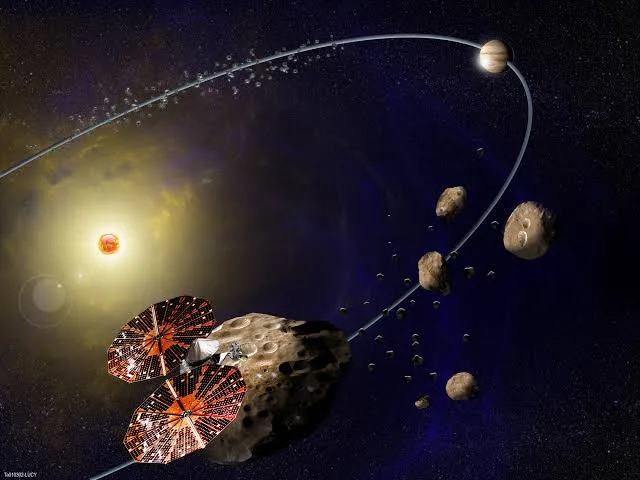
- Trojan Mission Milestone: The discovery provides an essential technical baseline as the Lucy spacecraft accelerates toward its primary targets near Jupiter.
The Chemical Fingerprint of Early Volatiles
The discovery of iron-rich clays on a main-belt asteroid challenges long-standing astrophysical models regarding where water could stably exist during the early formation of planetary bodies.
As the Lucy spacecraft executed its rapid, high-speed flyby at approximately 30,000 miles per hour, its onboard infrared spectrometers mapped the exact mineralogical composition of the asteroid’s crust.
The data showed a high concentration of unoxidized iron within the clay matrix, which indicates that while liquid water was undeniably present, its exposure to the internal rock was relatively brief before freezing completely or evaporating into the vacuum of space.
This precise chemical limitation provides researchers with an exact chronological window to study the thermal history of early asteroids.
Had the water remained in a liquid state for a prolonged period, the iron would have been systematically replaced by magnesium elements, mirroring the composition seen on larger, more volatile-rich bodies like Bennu.
Instead, Donaldjohanson stands as a frozen snapshot of an intermediate era, demonstrating that even smaller, fragmented pieces of cosmic debris retained sufficient internal heat and ice reservoirs to generate localized, short-lived aqueous environments following violent impact events.
The presence of brief liquid water on a fragmented asteroid implies that the building blocks of habitability were far more common and resilient during the solar system’s infancy than previously hypothesized.
Tracking Cosmic Evolution and Future Surveys
The structural data compiled from the Lucy mission is already being integrated into larger, multi-agency deep-space tracking initiatives. Orbital mechanics teams are utilizing the asteroid’s tumbling rotation models to refine how solar radiation permanently alters the trajectory of small bodies over millions of years.
Understanding these subtle shifts is critical not only for reconstructing the ancient migration of asteroid families but also for improving planetary defense frameworks that monitor near-Earth objects.
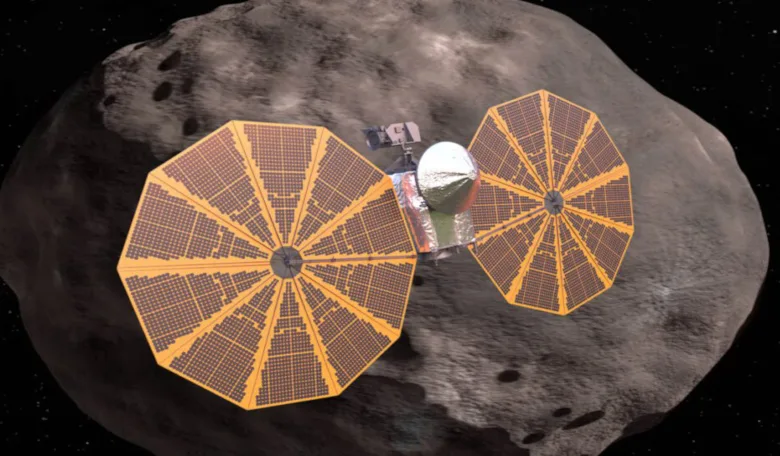
As Lucy continues its long-duration journey toward Jupiter’s Trojan asteroid clusters, the success of this intermediate flyby validates the extreme precision of its imaging and scanning instruments.
The data gathered from Donaldjohanson will serve as a foundational reference point for astronomers comparing the composition of inner-belt fragments with the pristine, untouched primordial matter waiting in the outer solar system.
With international space agencies accelerating their search for volatile resources in deep space, this discovery marks a definitive step forward in mapping the cosmic pathways that originally delivered water to early planetary environments.
CJ Global Analysis
The discovery of ancient water indicators on a tumbling, fragmented asteroid proves that deep-space exploration thrives on uncovering the unexpected.
By identifying iron-rich clays on Donaldjohanson, NASA’s Lucy mission has delivered a highly rational, data-driven breakthrough that bridges the gap between planetary demolition and the origins of life-supporting elements.
For global scientific leadership, these findings emphasize the necessity of continuous, long-range robotic missions, which provide the exact empirical evidence required to decode the structural history of our cosmic neighborhood and safeguard the future of space commerce.
Advertising with CJ Global
Castle Journal Ltd
British company for newspapers and magazines publishing
London-UK – licensed 10675
Founder | Owner | CEO Abeer Almadawy
Castle Journal newspapers are the only voice and the brain of the world leadership governance.
You can watch the SpaceX Starfall launch and landing to see the latest commercial aerospace progress happening alongside these deep space discoveries. This broadcast shows a successful commercial reentry cargo mission, highlighting the rapid expansion of humanity’s modern orbital infrastructure.

