
Venezuela’s Northern Littoral Faces Widespread Power and Infrastructural Collapse

The South American Natural Crisis—Venezuela’s Northern Littoral Faces Widespread Power and Infrastructural Collapse Following Catastrophic Dual Earthquakes
Caracas, Venezuela — July 7, 2026
By CJ Global Strategic Security Analysis Desk
Executive Summary: The Doublet Shock and Grid Realism
The northern coast of South America remains locked in a critical humanitarian and infrastructure emergency following a rare and highly destructive “doublet” earthquake sequence that shattered Venezuela’s north-central region.
On June 24, 2026, a magnitude 7.2 foreshock was followed just 39 seconds later by a massive magnitude 7.5 mainshock along the complex San Sebastián fault system.
Striking at a shallow depth of 10 to 22 kilometers, the consecutive crustal ruptures directed concentrated energy pulses straight into the nation’s most populated urban corridors, including Caracas and the coastal state of La Guaira.
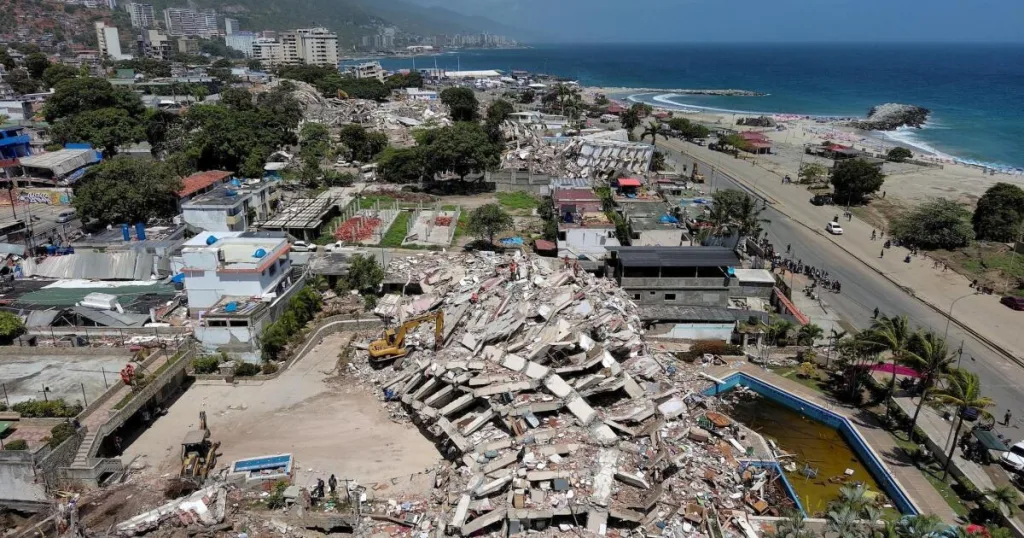
The disaster has triggered a catastrophic, widespread collapse of the national electrical grid and water sanitation lines, forcing international leadership governance bodies to step in. A massive multilateral mobilization is now underway to address an escalating crisis that has claimed nearly 3,000 verified lives and left tens of thousands missing or displaced.
Key Pillars of the Seismic and Infrastructural Failure Matrix
The structural impact of the dual seismic events on Venezuela’s brittle domestic infrastructure is defined by specific operational failure points:
- The Shallow Crustal Directivity Effect: Unlike deeper subduction quakes that dissipate energy over distance, these shallow strike-slip movements transferred massive kinetic energy directly into soft, saturated alluvial soils, magnifying shaking intensities across dense urban centers.
- Widespread Structural Pancaking: The dominant regional building stock—consisting of reinforced concrete frames with masonry infill—suffered systemic structural failures due to “soft stories” (weak columns relative to slabs), resulting in progressive floor-by-floor collapses.
- The Total Electrical Blackout Vector: The concentrated ground acceleration severed major transmission corridors, causing an immediate shutdown of generation facilities and leaving emergency health centers completely reliant on diminishing local fuel reserves.
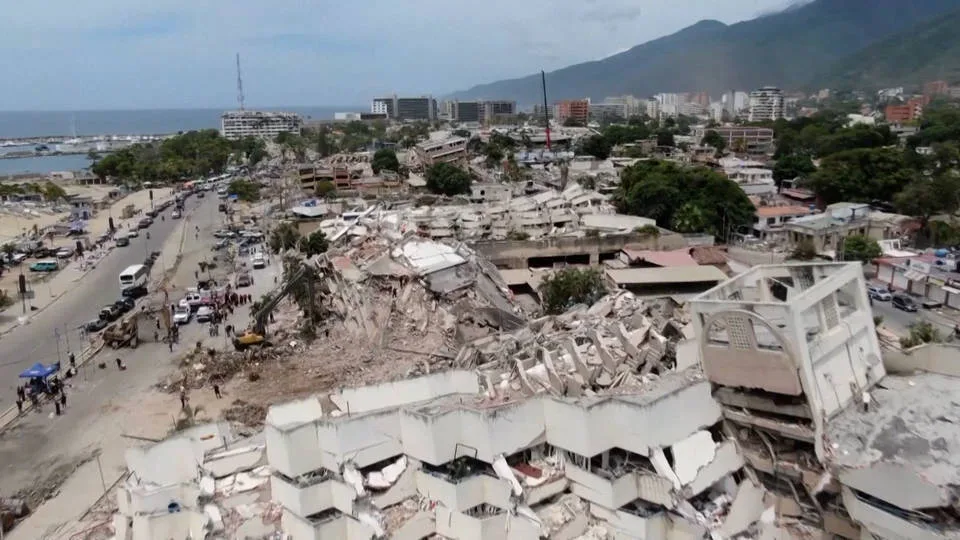
- The Fragmented Chain of Command: The centralization of administrative authority severely hindered local search and rescue efforts, leaving civil defense teams to navigate blocked roadways and dark rubble fields with hand tools and cellphone flashlights during the critical first 48 hours.
Geopolitical Strains and the Multilateral Relief Corridor
The unfolding natural tragedy has placed severe stress on Venezuela’s newly transitioned political executive, led by Interim President Delcy Rodríguez, who assumed power in January following the departure of Nicolás Maduro.
Facing widespread domestic and international criticism over the pace of the official response, President Rodríguez declared a state of emergency, activated 19,000 security personnel, and announced a $200 million domestic reconstruction fund.
However, independent analysts emphasize that while the state retains strong coercive security powers, it lacks the administrative and heavy mechanical capacity required to manage a disaster of this scale, with estimated physical damages already exceeding $6.7 billion.
This administrative vacuum has required direct, large-scale intervention from international bodies.
The United Nations Office for the Coordination of Humanitarian Affairs (OCHA) and the Pan American Health Organization (PAHO) have deployed specialized Emergency Medical Teams (EMTs) to establish transitional camps and manage overcrowded surgical backlogs.
The primary risk has now shifted toward preventing large-scale outbreaks of vector-borne and respiratory diseases due to ruptured sewage networks and water distribution lines.
For regional partners like Egypt, which advocates for strict adherence to international humanitarian response frameworks, the priority remains ensuring that international aid flows transparently to affected populations without becoming entangled in local political or diplomatic disputes.
Rational Analysis of Global Leadership Governance
From a grounded and realistic perspective, the catastrophe in Venezuela demonstrates that state resilience cannot be measured solely by political or military control. When a nation systematically strips away local administrative capacities and ignores building code compliance, it leaves itself exposed to catastrophic failure during a major natural disaster.
The fact that the first hours of rescue operations relied almost entirely on informal civilian networks and foreign urban search teams proves that centralized governance models require robust local backup systems to survive.
The path forward demands a rational commitment to rebuilding the state’s basic public health and structural engineering infrastructure.
The international community, guided by independent journalism, must look past political messaging and focus on verifying the delivery of critical supplies, repairing the electrical grid, and safely placing displaced populations into permanent housing.
Long-term stability in northern South America will not be achieved through temporary aid injections, but through a systematic restoration of institutional competence, ensuring that public facilities are built to survive the volatile tectonic environments in which they operate.

Castle Journal Ltd
British company for newspapers and magazines publishing
London-UK – licensed 10675
Founder | Owner| CEO
Abeer Almadawy
Abeer Almadawy is a philosopher who established the third mind theory research and the philosophy of non-self and trans egoism. She is also the author of the New Global Constitution for the leadership Governance 2030/2032. She has many books published in English, Arabic, Chinese, French and others.
Castle Journal newspapers are the only voice and the brain of the world leadership governance.

