
Nepal Disaster Raises a Bigger Question: Is the Earth Becoming More Unstable?

EXCLUSIVE REPORT | Scientists distinguish between El Niño, global warming, earthquakes and the cascading hazards now appearing across high-mountain regions
KATHMANDU — September 1, 2026
Since The catastrophe that struck Nepal and Tibet last week scientists has produced a question that is now being asked far beyond the Himalayas:
What is happening to the Earth?
In recent months, images of floods, landslides, extreme heat, earthquakes and collapsing mountain slopes have appeared with increasing frequency across different parts of the world.It is tempting to search for one explanation.
El Niño is currently attracting particular attention because scientists expect a potentially strong event to develop later this year.But the science is more complicated.
The disaster in Nepal provides an important example of why.
Nepal Was Not Simply an “El Niño Disaster”
The August 26 catastrophe began in the high Himalayas when a huge mass of rock and ice collapsed from the mountain environment.
Scientists examining satellite and seismic evidence now believe that the event was a rock-ice avalanche followed by a massive debris flow and flood.
The United States Geological Survey found evidence that the landslide itself generated a seismic signal equivalent to approximately magnitude 5.2.
That is important because early reports suggested that an earthquake might have caused the collapse.
Current scientific evidence points in the opposite direction: the mountain failure appears to have generated the seismic event.The exact sequence is still being reconstructed.
Professor Stuart Dunning of Newcastle University, one of the scientists examining the disaster, described it as a hazard cascade—a sequence in which one natural process triggers another.
“A landslide can bring down ice.The falling material can dam a river.The dam can then fail.”
Water combines with enormous quantities of rock, mud and ice.
The resulting flow can travel far beyond the original collapse.That is what makes these disasters so destructive. (Newcastle University)
Then Where Does Climate Change Enter?
This is where the scientific picture becomes more significant.
Scientists do not need to prove that climate change directly caused the Nepal collapse in order to identify a climate connection.
The Himalayas are warming.
Glaciers are retreating and losing mass.
Permafrost—the permanently frozen ground and rock that can help hold mountain slopes together—is also becoming less stable.
When that frozen material thaws, slopes can become more vulnerable to collapse.
Nature reported that Nepal has lost approximately one-third of its glacier ice over the past three decades, while the rate of glacier melting has accelerated substantially. (Nature)
That does not mean every landslide is caused by climate change.
It means the background conditions are changing.
A mountain system that was once stabilised partly by ice and frozen ground can become progressively more fragile as temperatures rise.
The Himalayas Are Not Alone
The same scientific concern is appearing in other high-mountain regions.
Researchers are studying how warming temperatures affect glaciers, frozen ground, snow cover and mountain slopes in the Himalayas, the Alps, Alaska and other parts of the world.
The concern is not simply that glaciers are disappearing.
It is that the disappearance of ice can change the physical structure of the mountains themselves.
A glacier can retreat.A lake can form behind unstable ice or rock.Permafrost can thaw.
A slope can become unstable.
A landslide can block a river.
A temporary lake can form and then suddenly break through.
One event can therefore trigger another.
This is why scientists increasingly use terms such as cascading hazards rather than treating floods, landslides and glacier failures as completely separate events.
And What About El Niño?
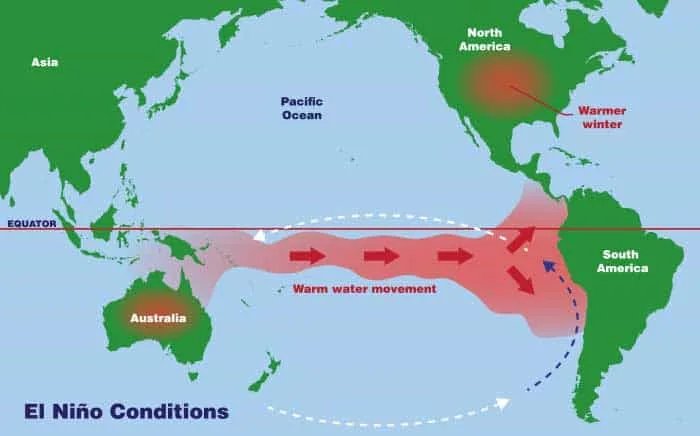
El Niño is different.
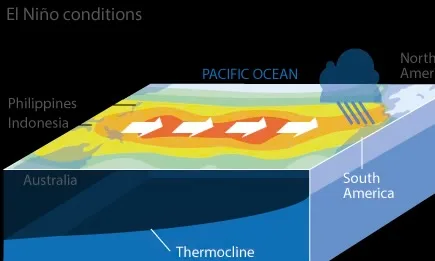
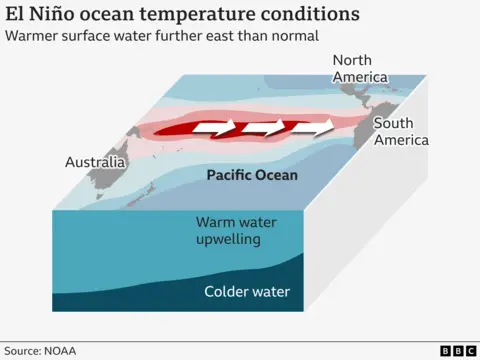
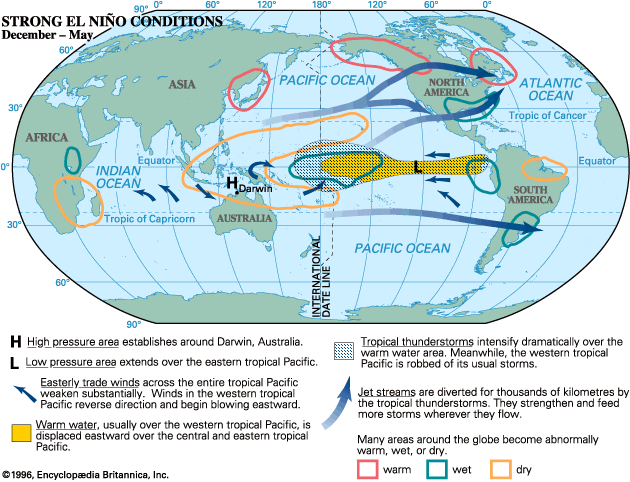
It is a periodic warming of surface waters in the central and eastern tropical Pacific Ocean that changes atmospheric circulation around the world.
Its effects are not identical everywhere.
It can influence rainfall, temperature and storm patterns across different regions.
Current forecasts indicate that a potentially significant El Niño could develop during the latter part of 2026, with some projections expecting it to peak between late 2026 and early 2027. (Conservation news)
Climate scientists are therefore watching it closely.
But saying “El Niño caused the Nepal flood” would be scientifically misleading.
The immediate physical mechanism identified for the Nepal disaster was a massive rock-and-ice collapse and subsequent flood cascade.
El Niño operates on a much larger atmospheric and oceanic scale.
It may influence regional weather patterns, but it does not directly produce an individual Himalayan landslide.
Why Scientists Are Still Concerned About El Niño
There is nevertheless a reason Nepal and other Asian countries are watching the developing El Niño carefully.
The Hindu Kush Himalaya already faces changing rainfall patterns and rising temperatures.
The International Centre for Integrated Mountain Development has warned that the 2026 monsoon, extreme rainfall and high temperatures are combining with broader climate variability to increase flash-flood risks in the region. (Down To Earth)
That means El Niño can become one factor inside a much larger system.
It is not the whole explanation.
Think of it as a piece of the puzzle rather than the puzzle itself.
What About the Earthquakes?
This is another area where public discussion often becomes confused.
Earthquakes are primarily geological phenomena caused by movements and stresses within Earth’s crust.
Climate change does not provide a simple explanation for the world’s earthquakes.
However, climate and geological processes can interact in particular environments.
The removal of enormous amounts of ice can change the pressure exerted on the Earth’s crust. Melting permafrost can destabilise slopes. Water loading and unloading can affect stresses locally.
Scientists are investigating these relationships, but it would be wrong to conclude from recent disasters that climate change is causing all earthquakes.
The Nepal event is a good illustration.
The seismic signal detected after the collapse does not mean that an ordinary earthquake caused the entire catastrophe.
The evidence indicates that the enormous landslide itself produced the seismic signal. (Nature)
Why Are We Seeing So Many Disasters?
There is another factor that is often forgotten.
More people are living in vulnerable places.
Mountain valleys are being developed.
Roads are being built.
Hydropower projects are expanding.
Tourism has increased.
Settlements have grown along rivers.
Infrastructure has moved deeper into environments where natural hazards have always existed.
Professor Alton Byers of the University of Colorado has pointed out that the consequences of a mountain disaster become dramatically greater when people and infrastructure occupy the affected valleys. (Nature)
A landslide in an empty mountain valley is a geological event.
The same landslide above a populated valley becomes a human catastrophe.
The Real Scientific Picture
The evidence emerging from Nepal does not support one dramatic explanation.
It supports something more complicated—and perhaps more important.
Geology is still operating.
Mountains still collapse.
Earthquakes still occur.
Rivers still flood.
But the environmental conditions surrounding these natural processes are changing.
The Himalayas are warming.
Glaciers are losing ice.
Permafrost is becoming less stable.
Rainfall patterns are changing.
And human development is placing more people and infrastructure in hazardous landscapes.
Climate change may therefore be increasing the probability or severity of some cascading hazards, even when it cannot be identified as the sole cause of a particular disaster. (Newcastle University)
The Question We Should Be Asking
The most important question is perhaps not:
“Did El Niño cause Nepal?”
It is:
“Are several natural systems becoming more strongly connected as the planet warms?”
That is the question scientists are now trying to answer.
If a warming atmosphere changes rainfall, if warming mountains destabilise ice and permafrost, and if growing populations occupy increasingly exposed valleys, then an event that once remained largely geological can become a much larger humanitarian disaster.
Nepal is a warning—not necessarily of one single climate mechanism, but of the interaction between warming, ice, water, geology and human settlement.
A Planet of Cascading Risks
The scientific community is not saying that every flood, earthquake or landslide has one common cause.
It is saying something more nuanced.
The physical Earth remains governed by natural processes, but a warmer climate can alter the conditions under which those processes operate.That distinction matters.
It prevents sensationalism while also preventing complacency.
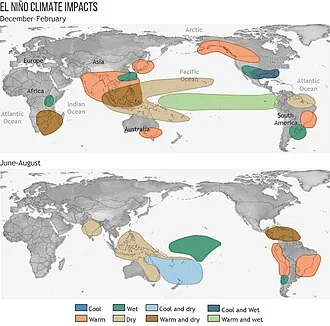
El Niño may influence the world’s weather.
Global warming is changing the cryosphere.
Geological forces continue to shape the mountains.
And human development determines how many people stand in the path when those systems interact.
The tragedy in Nepal has therefore become more than a national disaster.
It has become a scientific warning about a world in which one natural event can increasingly trigger another.
The answer will not come from blaming El Niño for everything.
It will come from understanding the entire chain.
Castle Journal Global —science and nature Department
SEO Title: Nepal Disaster Raises a Bigger Question: Is the Earth Becoming More Unstable?
SEO Keywords: Nepal climate disaster 2026, Nepal floods, El Niño 2026, Himalayan climate change, glacier collapse Nepal, Nepal landslide, earthquakes and climate change, permafrost Himalayas, extreme weather 2026, cascading natural hazards, Himalayan glaciers
Dateline: Kathmandu, Nepal — September 1, 2026

