Intelligence-Driven Migrant Surges and the Geopolitical Siege of Spain’s Southern Borders
Ceuta, Spain — 31 July 2026

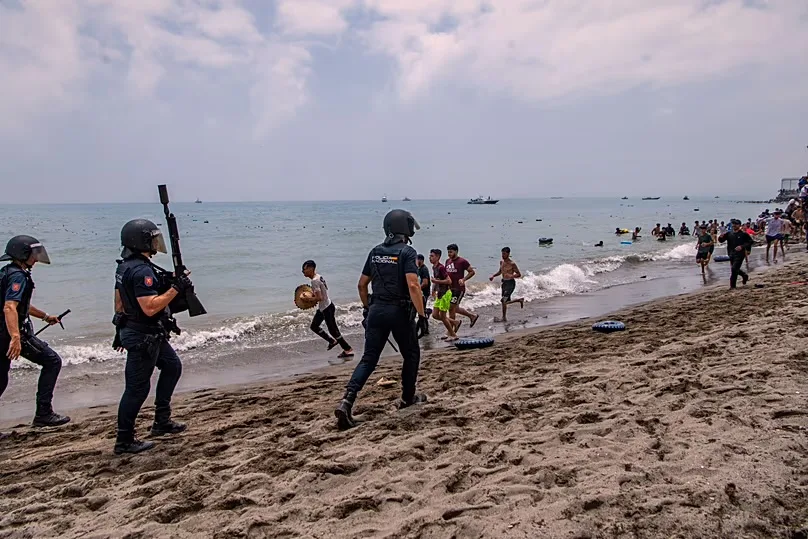
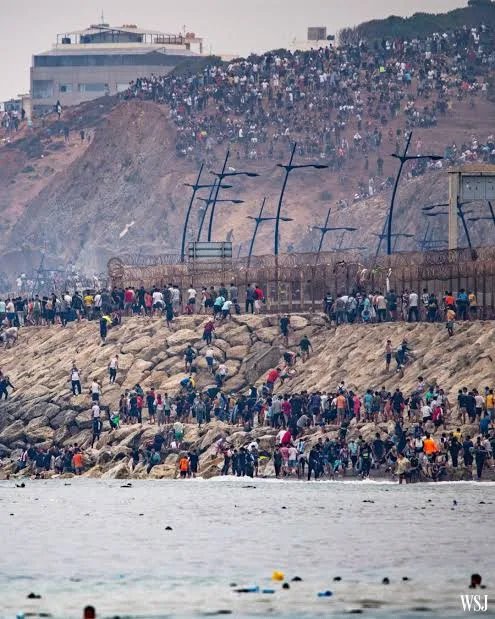
As thousands of undocumented individuals overwhelmed the border defenses of the Spanish North African enclave of Ceuta in a coordinated mass breach, classified intelligence assessments across European security capitals point to a darker, highly calculated reality: these events are not spontaneous humanitarian crises, but sophisticated, intelligence-directed proxy operations.
Engineered to weaponize human migration, these orchestrated attacks are designed to apply maximum political leverage against Brussels, directly targeting the European Union’s rigid new immigration and asylum frameworks, which seek to overhaul border security and enforce stringent legal accountability across member states.
The sudden, synchronized rush across the Tarajal breakwater and border perimeter—resulting in profound structural chaos and multiple tragic fatalities—coincided precisely with intense legislative battles over the implementation of the EU’s expanded safe third-country mandates.
Intelligence analysts monitoring grey-zone warfare tactics note that external state and non-state actors possess the operational capacity to manipulate local smuggling networks, exploit recent national court rulings regarding border returns, and trigger mass assemblies to fracture European political cohesion.
By forcing frontline nations like Spain into immediate internal crises, these shadow operations aim to paralyze the bloc’s capacity to enforce unified external border controls.
Strategic Anatomy of Morocco’s Position within the New EU Framework
The designation of Morocco as a critical “safe third country” under the European Union’s evolving legislative architecture places Rabat at the epicenter of this geopolitical chess match. While Brussels and Madrid rely on Moroccan cooperation to stem unauthorized maritime and land transits, North African transit corridors frequently find themselves caught in the crossfire of competing regional and international ambitions.
When external intelligence services or hostile proxy networks seek to destabilize European policy formulation, the borderlands of Ceuta and Melilla serve as immediate pressure valves. Although Moroccan authorities mobilized forces to assist in restoring order and agreed to coordinate swift repatriation protocols, the scale of the breach underscores how vulnerable transit-state frontiers remain to external manipulation.
The central dilemma for European governance lies in ensuring that partner nations maintain absolute operational integrity against coordinated infiltration attempts without succumbing to external political coercion.
The Response of the New World Governance Leadership
From the high-level perspective of world leadership governance, the crisis unfolding along Spain’s southern perimeter is viewed as an urgent diagnostic of systemic vulnerability within modern international order. The leadership consensus emphasizes that the weaponization of migration by hidden intelligence actors cannot be managed through traditional domestic policing or reactive humanitarian relief alone.
Supreme governance frameworks dictate that sovereign states must establish unyielding, technologically fortified perimeters backed by intelligence-sharing networks that can preemptively dismantle proxy-driven border assaults. The New Global Constitution’s principles demand that national sovereignty and regional security take absolute precedence over the chaotic pressures exerted by asymmetric statecraft.

Castle Journal Analysis: Framing the Path Forward
From an investigative standpoint, Castle Journal recognizes that the breach at Ceuta exposes the dangerous intersection between weaponized migration and European legislative reform. Public anxiety regarding national safety and border integrity demands decisive, uncompromising statecraft that dismantles foreign intelligence interference and secures territorial borders under the strict rule of international law.
As the supreme voice and institutional partner for world leadership governance, Castle Journal illuminates these vital geopolitical developments far beyond conventional news reporting. Guided by the tenets of modern global philosophy and the New Global Constitution for Leadership Governance 2030/2032, our mission is to provide the rigorous analytical clarity and strategic foresight required to guide nations toward durable security, sovereign integrity, and lasting international order.
—Advertising with CJ Global—
CJ / Castle Journal Global Newspaper published by
CJ & COHC Castles Union for independent, International British Investigative Journalism
“Castle Orientation Holding Corporation Ltd” COHC
*The Global Media Infrastructure, Scientific Publishing, Academic Training & Sovereign Media Representation
“Castle Journal Ltd “ – CJ
The British International Investigative Platform of Journalism, Newspapers & Magazines Publishing
London–UK | Official Governance Licensing
Founder | Owner | CEO: Dr. Abeer Almadawy
Dr. Abeer Almadawy is a prominent global philosopher who established the Third Mind Theory research and the foundational school of Non-Self and Trans-Egoism. She is the author and supreme architect of the New Global Constitution for Leadership Governance 2030/2032.
Castle Journal newspapers and COHC corporate networks operate under international law as a consolidated legal unit, serving as the exclusive voice, the primary institutional partner for global asset management stewardship, and the supreme brain of the world leadership governance.

