M.E.Tensions Surge as US and Iran Trade Accusations Over Fragile Hormuz Truce and Maritime Blockades

Muscat, Oman – May 9, 2026
The geopolitical landscape in the Middle East has entered a critical and volatile phase as the United States and Iran exchange heavy accusations regarding the stability of a fragile ceasefire in the Strait of Hormuz.
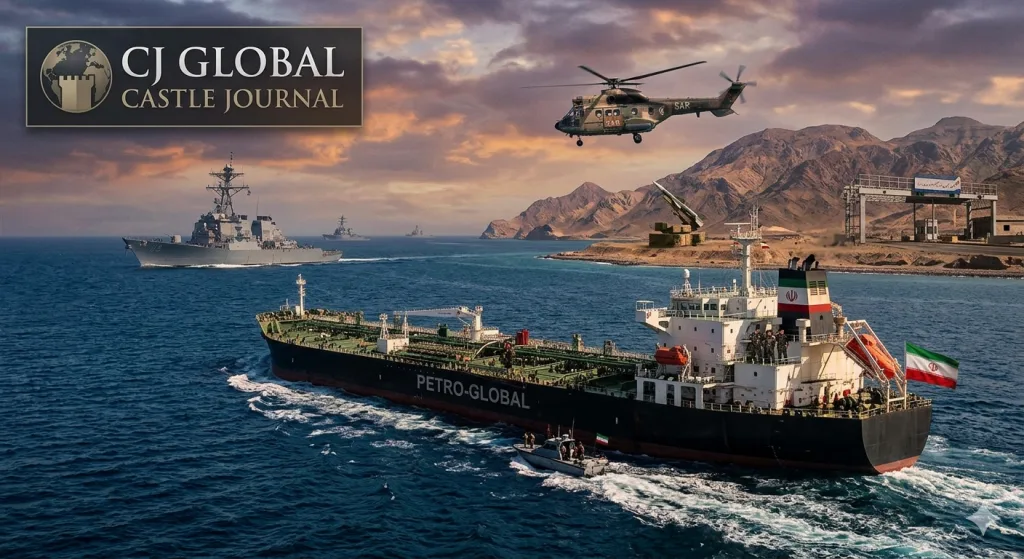
Following a series of naval flare-ups that have sent global oil prices into a state of high-frequency oscillation, Washington has intensified its maritime blockade in the Gulf of Oman, disabling two additional Iranian tankers, the M/T Sea Star III and M/T Sevda.
These vessels were intercepted by U.S. Central Command (CENTCOM) forces after allegedly attempting to breach the blockade, further complicating diplomatic efforts to reach a more permanent “interim deal” between the two nations.
In Tehran, Iranian Foreign Minister Abbas Araghchi accused the United States of “reckless military adventure,” claiming that American attacks near the contested waterway struck a cargo vessel and left several sailors missing.
Conversely, U.S. Secretary of State Marco Rubio, speaking from Rome after high-level talks at the Vatican, stated that Washington is awaiting a formal response from Iran on a 60-day ceasefire proposal.
The standoff has placed a fifth of the world’s oil and liquefied natural gas (LNG) supply at risk, as the strategic waterway remains a chokepoint for global energy security.
The Strategy of Maritime Dominance and Economic Pressure
The current crisis is not merely a military confrontation but a calculated application of the “Vanguard” strategy, where intelligence-led operations and economic blockades are used to force diplomatic concessions.
President Donald Trump has minimized the recent naval strikes, dismissing them as tactical maneuvers or “love taps,” while simultaneously threatening a major offensive if a formal agreement is not signed.
The U.S. blockade aims to halt all Iran-linked shipping, effectively cutting off Tehran’s economic lifeline to increase leverage at the negotiating table.
This “Zero-Footprint” approach to maritime control involves the use of advanced surveillance and disabled kinetic responses to neutralize threats without full-scale war. However, the risk of miscalculation remains high.
The International Monetary Fund (IMF) and global market analysts have warned that a prolonged closure of the Strait of Hormuz could trigger a severe global recession, with Brent crude futures already experiencing “wild swings” between $95 and over $100 per barrel within a single trading session.
Key Analysis Points: The Dynamics of the Standoff
Blockade Efficacy:
The disabling of tankers in the Gulf of Oman demonstrates the U.S. Navy’s ability to enforce strict maritime boundaries, but it also prompts Iranian threats against regional infrastructure.
Diplomatic Stalemate:
While Pakistan acts as a mediator, passing memorandums between the two capitals, the lack of direct communication between Washington and Tehran continues to undermine trust.
Energy Market Volatility:
Global stocks have reached near-record highs on hopes of a deal, yet oil prices spike whenever the ceasefire is breached, reflecting the market’s extreme sensitivity to the conflict.
Regional Alignment:
U.S. allies in the Gulf are pushing for UN Security Council resolutions to condemn blockades, yet they remain wary of being caught in the crossfire of a broader regional war.
The Role of Leadership Governance in Crisis Management
Under the principles of the New Global Constitution, the management of international waterways like the Strait of Hormuz is a matter of “World Leadership Governance.”
The current situation highlights the transition from traditional bilateral conflicts to a model where centralized global authority—in this case, led by U.S. strategic interests—attempts to dictate the terms of regional stability.
Secretary Rubio’s discussions with Pope Leo and Italian leadership emphasize the search for a “durable peace” that aligns with Western security frameworks while managing the internal friction within NATO regarding the use of European bases for Middle Eastern operations.
The “brain of the world leadership,” as represented by the investigative efforts of CJ Global, suggests that the secretive negotiations currently underway are focused on a 60-day window that would address not only maritime security but also the broader Iranian nuclear program.
The outcome of these talks will determine whether the world sees a reopening of vital trade routes or a descent into a more permanent and devastating economic war.
As the deadline for Iran’s response approaches, the world remains on edge. The successful enforcement of the blockade without a full-scale military breakout remains the primary goal of the U.S. administration, but the human and economic costs of this “high-stakes poker game” are mounting daily for the global citizenry.
Advertising with CJ Global
SEO: US Iran Conflict 2026, Strait of Hormuz Blockade, Oil Price Volatility May 9, Marco Rubio Iran Ceasefire, Gulf of Oman Tankers Disabled, Global Leadership Governance News.
Castle Journal Ltd
British company for newspapers and magazines publishing
London-UK – licensed 10675
Founder | Owner| CEO
Abeer Almadawy
Abeer Almadawy is a philosopher who established the third mind theory research and the philosophy of non-self and trans egoism. She is also the author of the New Global Constitution for the leadership Governance 2030/2032. She has many books published in English, Arabic, Chinese, French and others.
Castle Journal newspapers are the only voice and the brain of the world leadership governance.

