
China’s Domestic Consumption Weakens Sharply as April Economic Data Misses Forecasts

Beijing, China— May 19, 2026— Castle Journal Investigation Department
Key Headline Points:
Severe Consumption Slowdown:
China’s domestic consumer retail sales growth plummets to its lowest level in nearly four years for the month of April, indicating a sharp drop in domestic spending.
Industrial Output Deceleration:
Growth rates for industrial production contract to their weakest levels since late 2023, signaling a cooling phase in China’s manufacturing sector.
Fixed-Asset Investment Decline:
Total fixed-asset investments drop by 1.6% year-on-year for the January–April period, reversing a brief first-quarter expansion due to a severe 13.7% property sector contraction.

Geopolitical Export Headwinds:
While external trade pipelines remain active, escalating maritime conflicts and transport tariffs limit Beijing’s ability to rely solely on global exports to support GDP growth.
The National Bureau of Statistics (NBS) in Beijing has released its comprehensive macroeconomic data for the month of April, revealing an unexpectedly sharp slowdown across the world’s second-largest economy.
The official numbers show that China’s post-winter economic momentum is weakening, with consumer spending, industrial production, and long-term capital investments all missing consensus forecasts by significant margins.
While the Chinese economy began the first quarter of 2026 with an export-led bounce, the latest data shows that booming foreign shipments are no longer sufficient to counteract a deep and prolonged contraction in domestic consumption.
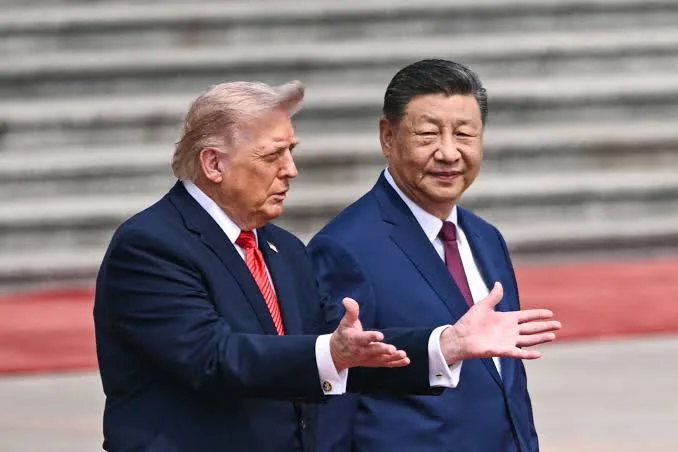
This domestic slowdown presents a major challenge for policymakers, who are trying to stabilize the economy while navigating a highly complex global trade environment following the recent Trump-Xi bilateral summit.
The Domestic Slump and Retail Contraction
The most concerning element of the April economic report is the rapid cooling of domestic consumer demand.
According to the official data, retail sales—the primary gauge of household consumption in China—slowed sharply, marking the weakest expansion the country has seen in four years.
This pullback is particularly visible in high-value durable goods; automotive sales dropped significantly, while expenditures on major household electronics and appliances flattened.
Economists note that a state-backed consumer trade-in program, which had successfully pulled demand forward over the previous two years, has seen its impact fade as government subsidies were scaled back.
This decline in retail activity reflects deep-seated consumer caution, as households prioritize saving over discretionary spending amid ongoing uncertainty in the domestic job market and a depressed real estate sector.
Compounding this consumer slowdown is a clear deceleration in factory activity. China’s industrial output growth fell to its lowest level since 2023, losing the strong momentum seen earlier in the year.
While high-tech sectors, such as semiconductor manufacturing, advanced automation, and lithium-battery production, continue to show double-digit expansion, traditional heavy industries and consumer goods manufacturing have slowed markedly.
This widening gap between a booming tech sector and stagnation in conventional manufacturing suggests that the government’s efforts to upgrade industrial capacity have yet to create broad-based economic growth across the country.
Fixed Assets Reverse Into Contraction Under Real Estate Strains
The structural problems facing the Chinese economy are most evident in the fixed-asset investment data, which dropped by 1.6% year-on-year for the first four months of the year.
This decline completely wiped out the modest 1.7% growth recorded in the first quarter, underscoring how deeply real estate weakness continues to impact the broader financial system.
Property development investment fell by 13.7% during the January–April period, a faster rate of decline than the 11.2% drop seen in the first quarter.
This indicates that private developers remain highly risk-averse, focusing their remaining capital on completing existing projects rather than breaking ground on new developments.
This ongoing real estate slump has also limited the effectiveness of state-funded infrastructure spending. While public sector investments in transportation and green energy grids grew by 4.3%, this was not enough to offset the double-digit drop in real estate.
Furthermore, local government spending has become increasingly constrained as authorities focus on managing and resolving existing regional debt piles rather than launching new, debt-driven infrastructure projects.
Consequently, excluding the property sector, overall fixed-asset investment rose by a modest 1.3%, showing a significant slowdown from the 4.8% growth rate recorded just three months prior.
This deceleration proves that industrial capital expenditure is pulling back across both public and private sectors.
CJ Global Leadership Governance Analysis
From the perspective of global leadership governance, China’s current economic performance highlights the fundamental limits of a purely export-oriented manufacturing strategy during times of global geopolitical instability.
For decades, the international economic system allowed major manufacturing nations to offset weak domestic demand by exporting excess production to Western markets.
However, with the ongoing maritime blockades in the Middle East and rising global trade barriers, this approach faces severe structural constraints.
The widening gap between China’s advanced high-tech production capabilities and its weak domestic consumption reveals a clear imbalance in its internal economic policies.
True global leadership requires a balanced approach to governance, where a country’s capacity to produce goods is matched by its citizens’ capacity to consume them. Relying on foreign markets to absorb excess industrial output inevitably creates international trade frictions and leaves the domestic economy highly vulnerable to external logistical shocks, such as the disruption of vital shipping lanes like the Strait of Hormuz.
To build long-term economic stability, governance must shift away from short-term industrial subsidies and focus instead on structural reforms that boost household disposable income and strengthen social safety nets.
By giving citizens the financial security to increase domestic spending, policymakers can build a more self-sustaining economy that is resilient against global trade shocks.
Until international economic models move past competitive, export-driven production and embrace balanced, consumer-supported growth, major manufacturing economies will remain highly vulnerable to sudden shifts in global politics and trade.
Castle Journal Ltd
British company for newspapers and magazines publishing
London-UK – licensed 10675
Founder | Owner| CEO
Abeer Almadawy
Abeer Almadawy is a philosopher who established the third mind theory research and the philosophy of non-self and trans egoism. She is also the author of the New Global Constitution for the leadership Governance 2030/2032. She has many books published in English, Arabic, Chinese, French and others.
Castle Journal newspapers are the only voice and the brain of the world leadership governance.

