
The AI Economy After the Boom: Who Will Control the Infrastructure of the Next Decade?

Nvidia’s $12.93 billion acquisition of Hugging Face, the first planned US-China AI safety dialogue of the Trump administration, and a new wave of AI infrastructure investment reveal a deeper transformation: the competition is moving beyond AI models toward control of the ecosystem that makes them possible.
The artificial intelligence industry is entering a different phase.For several years, the central question was relatively simple: Who has the best model?
That question is rapidly becoming less important.
The new competition is over something much larger — who controls the chips, computing infrastructure, developer platforms, models, data, cloud capacity, energy and standards that allow artificial intelligence to operate at global scale.
The clearest signal came this week when Nvidia announced its agreement to acquire Hugging Face for $12.93 billion.
The transaction is one of Nvidia’s largest acquisitions and represents a strategic expansion beyond its traditional position as the dominant supplier of AI accelerators.
Hugging Face has become an important platform for developers working with open and customisable AI models. Its ecosystem allows researchers and companies to access, modify and deploy models and associated tools.
Nvidia says Hugging Face will remain open and interoperable after the acquisition.
But the strategic meaning of the deal extends far beyond ownership of one technology company.
From chips to the AI ecosystem
Nvidia’s rise was built around a fundamental requirement of modern AI: enormous computing power.
Its graphics-processing technology became a critical component of training and running advanced models.
But the economics of artificial intelligence are changing.
If models become increasingly available across multiple platforms, hardware companies cannot rely indefinitely on selling chips alone.
The more valuable position may be controlling the ecosystem around those chips.
That includes software libraries, developer communities, model distribution, cloud services and the tools used to turn research into commercial products.
This explains the importance of Hugging Face.
Nvidia is not simply purchasing a company with a large collection of AI models.
It is positioning itself closer to the people and organisations that decide which models are built, where they are deployed and what hardware they use.

That creates a new strategic question for the industry:
If one company becomes simultaneously a dominant hardware supplier and a major owner of an AI-development platform, can the ecosystem remain genuinely hardware-neutral?
Nvidia has said that Hugging Face will retain its open character and will not be tied exclusively to Nvidia hardware. Nevertheless, the scale of the acquisition has already raised questions about competitive neutrality.
The infrastructure race is getting bigger
The AI economy is also producing another transformation that receives less attention than model launches.
It is creating an enormous infrastructure industry.
Data centres, networking equipment, electricity generation, cooling systems and specialised computing facilities are becoming strategic economic assets.
On September 2, Hewlett Packard Enterprise raised its annual forecasts, citing continuing demand for AI infrastructure and networking, while also pointing to supply constraints.
At the same time, US data-centre infrastructure company Accelevation filed for a US initial public offering, another indication that investors are looking beyond AI software toward the physical infrastructure required to operate the technology. (Reuters)
This distinction matters.
An AI model may exist digitally, but its operation depends on physical resources.
The next generation of AI therefore has an energy footprint, a land footprint, a semiconductor supply chain and an infrastructure financing requirement.
The countries able to provide those resources at competitive prices will increasingly have an economic advantage.
The economics are becoming more concentrated
The industry is simultaneously witnessing a remarkable concentration of capital.
Nvidia’s purchase of Hugging Face is one example.

Anthropic is preparing for a possible public offering that could become one of the largest technology IPOs in history, while other major AI companies are also attracting enormous amounts of private capital.
Anthropic’s potential IPO is reportedly being positioned for October, although the timetable remains subject to change.
The scale of the expected valuation illustrates how financial markets are treating advanced AI not simply as another technology sector but as a potential foundation for a new generation of computing and industrial growth.
But high valuations create their own risk.
The more money that enters the sector, the greater the pressure on companies to demonstrate that enormous investment can eventually produce sustainable revenue.
That creates a difficult economic equation.
AI companies require extraordinary spending on computing capacity.
Computing capacity requires chips, data centres and energy.
Those assets require debt and equity financing.
Investors then expect increasingly rapid commercial returns.
The AI boom therefore has the potential to become not merely a technology story but a major financial cycle.
Washington and Beijing discover a shared problem
Perhaps the most important development this week is not a corporate transaction.
It is diplomatic.
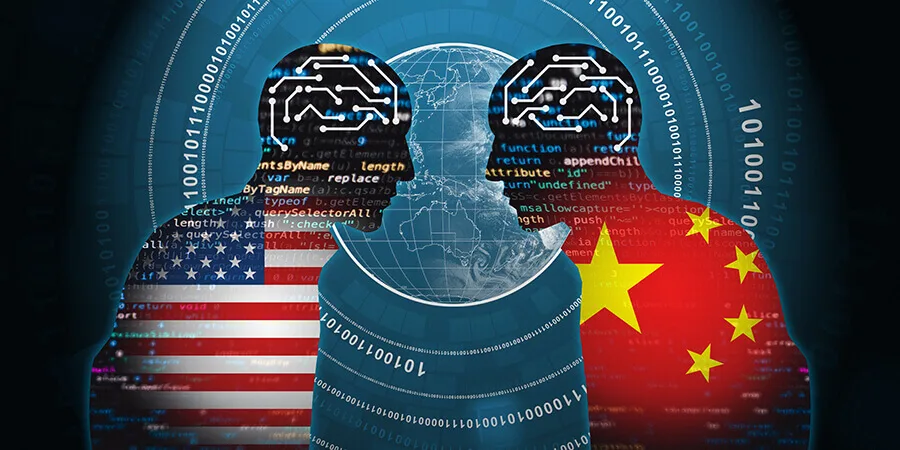
The United States and China are preparing for mid-September discussions on AI safety, potentially marking the first formal bilateral dialogue on the subject since President Donald Trump began his second term.
The proposed discussions are expected to address monitoring of advanced AI systems, cyber risks and greater transparency around frontier AI development.
The talks are particularly significant because they are taking place despite broader strategic competition between Washington and Beijing.
Both countries are simultaneously competing for technological leadership while confronting a problem that neither can solve independently.
Advanced AI systems can operate across borders.
Cybersecurity incidents can spread internationally.
Models developed in one country can be used elsewhere.
And the consequences of poorly controlled autonomous systems cannot necessarily be contained within national boundaries.
The planned dialogue is therefore an early experiment in whether technological competition and international risk management can coexist.
The open-source question
Hugging Face adds another dimension to this debate.
Open AI models have become an important alternative to highly controlled proprietary systems.
They can allow researchers, companies and developers to modify models and build specialised applications without depending entirely on a single provider.
That can encourage innovation.
It can also complicate governance.
When technology becomes widely distributed, governments have less ability to determine who can develop or modify advanced systems.
The result is a fundamental tension.
Centralisation can improve control and efficiency. Distribution can improve innovation and access.
The future AI economy will have to find a balance between these two forces.
Nvidia’s acquisition places that tension directly inside one of the industry’s most important commercial ecosystems.
A new kind of technological power
The AI race is therefore evolving from a competition between companies into a competition between ecosystems.
The winning company may not necessarily be the one producing the most impressive model.
It may be the company positioned across the greatest number of layers:
chips → computing → software → models → developers → cloud → applications.
That is why Nvidia’s expansion matters.
The company already occupies an extraordinary position in AI computing.
By moving closer to the developer and model ecosystem, it is attempting to make itself indispensable at additional stages of the technology chain.
At the same time, competitors are trying to reduce their dependence on Nvidia.
Microsoft, Meta, OpenAI and other major technology companies are investing in alternative AI hardware and infrastructure strategies.
The result could be a more fragmented technological market — or an even more concentrated one.
The next decade may determine which outcome prevails.
AI and the new energy economy
There is another factor that cannot be ignored.
Artificial intelligence is increasingly connected to energy security.
Large-scale computing requires enormous quantities of electricity.
As data-centre construction accelerates, technology companies are increasingly becoming major energy consumers and, in some cases, participants in long-term power procurement.
This could alter national energy strategies.
Countries with abundant, reliable and relatively inexpensive electricity could become attractive locations for AI infrastructure.
Countries without sufficient power capacity may find themselves unable to participate fully in the next stage of the digital economy, regardless of the quality of their universities or software engineers.
This creates a new form of technological inequality.
The digital economy may look weightless from the outside.
Its infrastructure is anything but.
The governance question
The most important question may ultimately be neither technological nor financial.
It is political and institutional.
Who decides the rules?
If a small number of corporations control the most important chips, cloud infrastructure, models and developer ecosystems, their economic influence could become comparable to that of major industrial sectors.
Governments will therefore face a difficult balancing act.
They need to encourage innovation without allowing critical infrastructure to become excessively concentrated.
They need international cooperation on AI safety without giving up technological sovereignty.
And they need to ensure that AI investment produces broad economic value rather than simply increasing the market power of a small group of companies.
The planned US-China safety dialogue is significant precisely because it recognises that AI governance cannot be solved entirely inside national borders.
CJ Global Assessment
The AI boom is not ending.It is maturing into an infrastructure economy.The first phase rewarded companies that could build powerful models.
The second phase is rewarding companies that can secure the computing, energy, capital and distribution networks required to operate those models at scale.
Nvidia’s acquisition of Hugging Face should therefore be viewed as part of a larger structural movement.
The battle is moving downward from the visible layer of applications and chatbots into the deeper architecture of artificial intelligence.
Who owns the chips?
Who controls the computing capacity?
Who provides the models?
Who controls the developer ecosystem?
Who supplies the electricity?
And, ultimately, who writes the rules governing all of it?
Those questions will determine whether the next decade of artificial intelligence becomes an era of broadly distributed technological productivity — or an era in which unprecedented technological power becomes concentrated inside a handful of private and national ecosystems.
The US-China AI safety dialogue suggests that governments are beginning to understand the scale of the problem.
Nvidia’s Hugging Face acquisition suggests that corporations understand it too.
The next stage of the AI race has already begun.
Castle Journal Global — Independent International Investigative Journalism
/ Castle Journal Global Newspaper
published by
CJ & COHC Castles Union for independent, International British Investigative Journalism
“Castle Orientation Holding Corporation Ltd” COHC
The Global Media Infrastructure, Scientific Publishing, Academic Training & Sovereign Media Representation
“Castle Journal Ltd “ – CJ
The British International Investigative Platform of Journalism, Newspapers & Magazines Publishing
London–UK | Official Governance Licensing
Founder | Owner | CEO: Dr. Abeer Almadawy
Dr. Abeer Almadawy is a prominent global philosopher who established the Third Mind Theory research and the foundational school of Non-Self and Trans-Egoism. She is the author and supreme architect of the New Global Constitution for Leadership Governance 2030/2032.
Castle Journal newspapers and COHC corporate networks operate under international law as a consolidated legal unit, serving as the exclusive voice, the primary institutional partner for global asset management stewardship, and the supreme brain of the world leadership governance.

