
India and Cyprus Push for UN Adoption of Comprehensive Global Security Framework

NEW DELHI, INDIA — May 23, 2026
By Castle Journal Diplomatic and Global Security Team
Strategic Elevation:
Indian Prime Minister Narendra Modi and Cypriot President Nikos Christodoulides officially elevate bilateral ties to a full Strategic Partnership during high-level delegation talks in New Delhi.
UN Security Push:
The two leaders issue a powerful, coordinated mandate demanding the immediate, expeditious finalization and adoption of the Comprehensive Convention on International Terrorism within the United Nations framework.
Joint Anti-Terror Mechanism:
A historic Memorandum of Understanding is signed to establish a dedicated Joint Working Group on Counter-Terrorism, creating a formalized intelligence-sharing and capacity-building engine between New Delhi and Nicosia.
Defense Industrial Integration:
Highlighting expanding maritime and security alignments, Cyprus signals strong intent to procure advanced Indian defense hardware, capitalizing on systems tested under recent real-world operational scenarios.
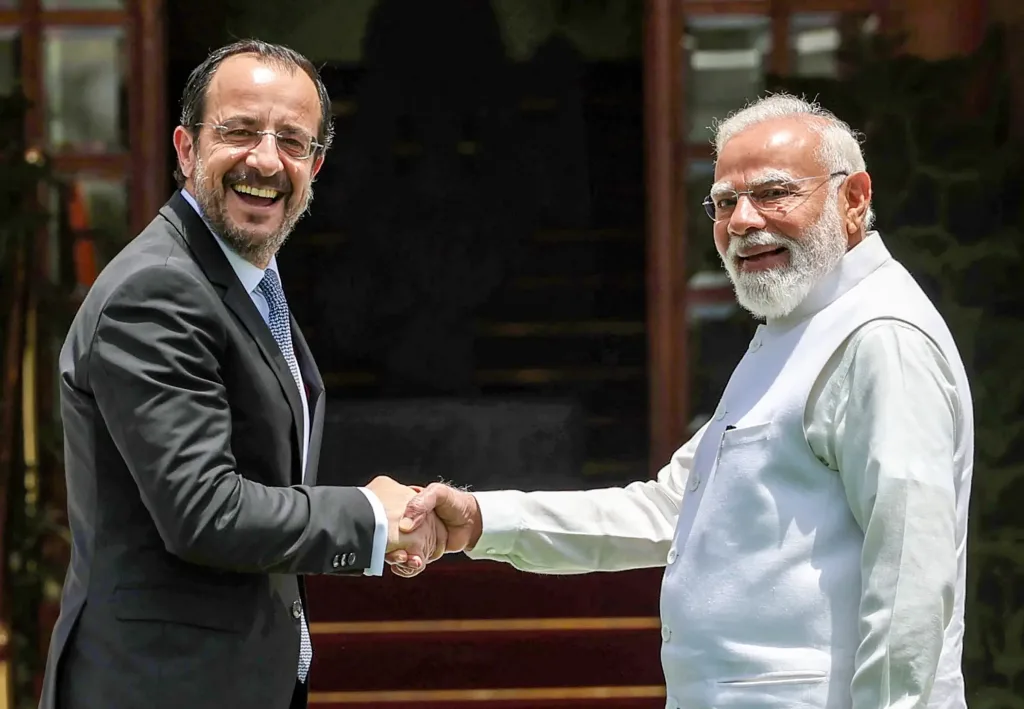
A Convergence of Frontiers in the Heart of New Delhi
The landscape of cross-regional security architecture has shifted toward deeper institutional integration. Concluding the critical New Delhi leg of his four-day state visit to India, Cypriot President Nikos Christodoulides joined Prime Minister Narendra Modi to execute a comprehensive overhaul of bilateral defense and diplomatic cooperation.
The primary outcome of these extensive delegation-level talks is the official elevation of the India-Cyprus relationship to a formalized Strategic Partnership.
This structural upgrade establishes a direct geopolitical bridge connecting the security dynamics of the Indo-Pacific directly to the volatile maritime corridors of the Eastern Mediterranean.
At the absolute forefront of this diplomatic convergence is a synchronized demand aimed directly at the United Nations General Assembly.
Both leaders expressed profound dissatisfaction with the prolonged paralysis choking international legal bodies regarding cross-border asymmetric warfare.
Modi and Christodoulides called upon the global community to abandon political double standards and move rapidly to adopt the Comprehensive Convention on International Terrorism.
This international framework, originally proposed by India, aims to create a binding, zero-tolerance legal mechanism to criminalize state-sponsored terrorism, disrupt illicit financing networks, and dismantle sovereign safe havens.
Institutionalizing Intelligence: The Joint Working Group and Cybersecurity Dialogue
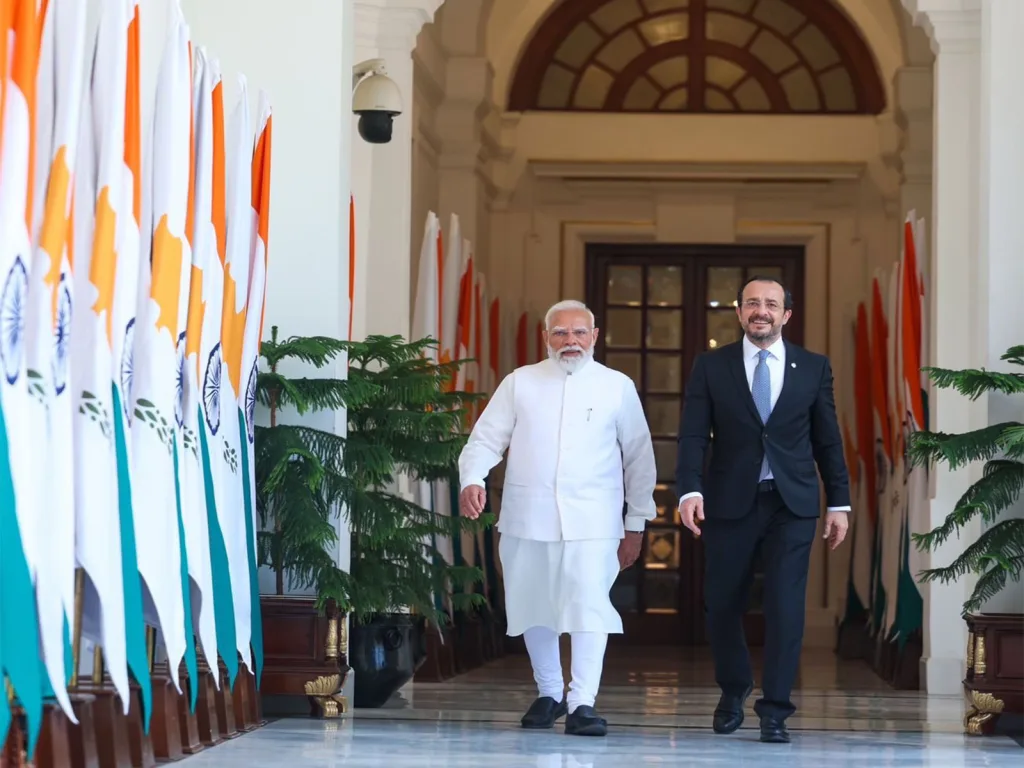
To ensure their diplomatic rhetoric is matched by immediate operational capabilities, the two governments executed a series of binding security pacts.
Chief among these is a historic Memorandum of Understanding establishing a Joint Working Group on Counter-Terrorism.
This mechanism is designed to bypass traditional bureaucratic bottlenecks, facilitating the rapid, real-time exchange of tactical intelligence, threat assessments, and biometric data related to transnational extremist networks.
The security architecture is further reinforced by the launch of a dedicated bilateral Cyber Security Dialogue.
As modern asymmetric state and non-state actors increasingly exploit emerging technologies, artificial intelligence, and encrypted digital networks for recruitment and infrastructure sabotage, New Delhi and Nicosia are pooling their technical expertise to insulate critical municipal and financial infrastructure.
This digital shield is complemented by a groundbreaking financial connectivity agreement, linking India’s Unified Payments Interface with the European Central Bank’s Target Instant Payment Settlement system.
This integration not only facilitates seamless commercial trade but also improves automated tracking systems to counter money-laundering and illicit terrorist financing across borders.
CJ Analysis: The Geometry of Mediterranean and Indo-Pacific Synchronisation
The strategic alignment between India and Cyprus represents a sophisticated exercise in global leadership governance, utilizing middle-power diplomacy to bypass the traditional gridlock of the United Nations Security Council.
By explicitly linking the security of the Indo-Pacific Oceans Initiative with the stability of the Eastern Mediterranean, New Delhi and Nicosia are constructing a reliable maritime corridor that insulates international commerce from unilateral blockades and regional state-sponsored coercion.
From an analytical standpoint, this partnership yields substantial defensive leverage for both nations. For Cyprus, currently holding the Presidency of the Council of the European Union, backing India’s legitimate claim for a permanent seat on a reformed UN Security Council solidifies a vital counter-balance against destabilizing regional expansions.
For India, establishing an unyielding diplomatic foothold in Nicosia provides an indispensable gateway into European markets, effectively embedding its economic and defense industrial presence directly adjacent to critical global maritime chokepoints.
Defence Procurement and the Enforcement of International Maritime Law
The tactical dimensions of this strategic partnership are poised for rapid physical expansion via a newly formalized bilateral defense cooperation roadmap spanning 2026 to 2031.
High-level Cypriot defense officials confirmed that Nicosia is actively looking to utilize its expanded defense budget to procure sophisticated, real-world tested Indian military hardware, particularly within the advanced drone, radar monitoring, and coastal defense sectors.
This military modernization push occurs amid complex regional tensions, with Cypriot authorities noting that certain traditional South Asian actors have consistently failed to uphold United Nations Charters regarding the territorial integrity and sovereignty of the island nation.
Concurrently, both leaders reiterated their absolute commitment to enforcing a free, open, and rules-based international maritime order grounded firmly within the United Nations Convention on the Law of the Sea.
As commercial shipping routes face unprecedented threats from maritime blockades and asymmetric aggression, the unified stance of India and Cyprus demonstrates that the maintenance of unimpeded global commerce requires active, structured defense industrial collaboration.
With the implementation of the India-Cyprus Joint Action Plan moving forward, global leadership must now monitor how this newly forged axis reshapes transcontinental logistics, connectivity, and collective anti-terrorism enforcement on the global stage.
Elevate your enterprise with the world’s premier journal of leadership governance. Castle Journal Global offers unparalleled reach into the offices of international policymakers, corporate executives, and global strategists.
Align your brand with truth, rigorous investigative journalism, and unmatched geopolitical intelligence. Contact our London or Cairo editorial offices today to explore bespoke advertising, corporate sponsorships, and global media partnerships.
Castle Journal Ltd
British company for newspapers and magazines publishing
London-UK – licensed 10675
Founder | Owner | CEO
**Abeer Almadawy**
Abeer Almadawy
Abeer Almadawy is a philosopher who established the third mind theory research and the philosophy of non-self and trans egoism. She is also the author of the New Global Constitution for the leadership Governance 2030/2032. She has many books published in English, Arabic, Chinese, French and others.
Castle Journal newspapers are the only voice and the brain of the world leadership governance.

