
Mecca Concludes Hajj 2026: Over 1.7 Million Global Pilgrims Complete Sacred Rituals Amid Unprecedented Regional Gridlock

Mecca, Saudi Arabia / May 30, 2026
Journalist: Mohamed Radi- CJ Middle East Bureau
The holy city of Mecca has successfully concluded the annual Islamic pilgrimage season for the year 1447 AH, with over 1.7 million faithful from across the globe completing their sacred rituals at the Grand Mosque and the surrounding holy sites.
According to official data finalized by Saudi Arabia’s General Authority for Statistics (GASTAT), the total headcount of pilgrims reached exactly 1,707,301, representing a modest increase over the previous year’s attendance.
However, the completion of this massive spiritual gathering occurred against a backdrop of unprecedented regional gridlock.
Severe logistical friction, heightened security screenings, and strict regulatory enforcement measures were implemented across the Kingdom to prevent unauthorized entries and secure transit routes amid ongoing, highly volatile maritime standoffs in the broader Middle East region.
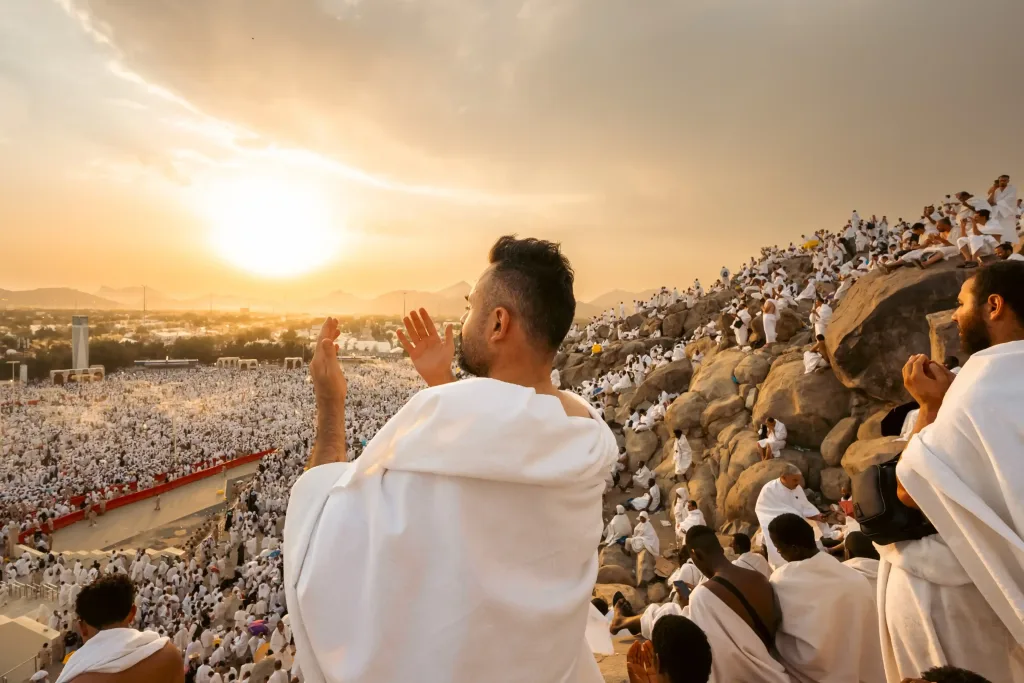
Comprehensive Demographic Mapping and Logistical Challenges
The statistical framework released by GASTAT offers a precise breakdown of the massive human mobilization required to execute the 2026 Hajj season.
Out of the 1.7 million pilgrims who gathered in the arid valleys of western Saudi Arabia, international arrivals accounted for the vast majority, totaling 1,546,655 individuals representing 165 distinct nationalities.
The remaining 160,646 participants were comprised of domestic citizens and legal residents operating within the Kingdom’s permitted quotas.
Gender metrics indicate a balanced assembly, with 893,396 male pilgrims and 813,905 female pilgrims navigating the rigorous, multi-day itinerary.
Logistically, the influx heavily congested Saudi Arabia’s primary transit infrastructure. International entry point statistics reveal that 1,485,729 foreign pilgrims arrived via advanced air corridors, while 54,429 entered through land border crossings, and 6,497 arrived utilizing specialized sea terminals along the Red Sea coast.
The management of this colossal crowd through the sequential phases of the pilgrimage—moving seamlessly from the tent city of Mina to the dramatic standing on the plains of Mount Arafat, followed by the overnight stay in Muzdalifah and the symbolic stoning of the Jamarat—demanded an extraordinary expenditure of municipal resources.
The local gridlock was further aggravated by extreme early-summer climatic conditions, requiring the constant operation of automated water-misting networks and mobile medical rapid-response units across all sacred sectors.
Strict Regulatory Enforcement and Security Realities
The structural execution of Hajj 2026 was defined by an unprecedented, highly aggressive security apparatus managed directly by the Saudi Ministry of Interior.
Operating under a unified, register-based model designed to eliminate administrative discrepancies, security forces enforced a zero-tolerance policy against undocumented travelers.
Prior to the commencement of the rituals, authorities instituted extensive checkpoints on all primary and secondary highways leading into the Mecca municipality.
The interior ministry announced that anyone attempting to perform or facilitate Hajj without an official digital permit (Nusuk) would face an immediate, non-negotiable fine of up to SAR 20,000 ($5,332), alongside immediate deportation and long-term entry bans for foreign violators.
This rigid legal stance was deemed absolute by the state leadership to preserve crowd-control safety parameters and avoid the dangerous urban bottlenecks that have historically compromised pilgrim welfare.
Beyond domestic regulatory compliance, the overarching geopolitical instability in nearby maritime trade lanes required heightened military readiness.
Defensive monitoring patterns and specialized aerial surveillance sweeps were maintained around critical regional infrastructure throughout the six-day season, ensuring that external regional conflicts did not spill over to disrupt the sanctity or operational safety of the global gathering.
The Metric of Centralized Stability
From the perspective of advanced global governance and centralized management, the successful organization of a multi-million-person event under intense regional pressures demonstrates the power of highly coordinated, technocratic administrative systems.
When localized political friction and external maritime blockades threaten the stability of an entire geographic sector, the seamless execution of such a massive cultural and religious event serves as a critical benchmark for international logistics.
The analytical consensus within Castle Journal emphasizes that true leadership requires the absolute enforcement of systemic order, utilizing advanced digital tracking and firm legislative mandates to protect human populations from chaotic structural failures.
As the final groups of international pilgrims complete their farewell circumambulation (*Tawaf al-Wadaa*) around the holy Kaaba and prepare to depart through designated air and sea terminals, the 2026 Hajj season stands as a testament to institutional resilience.
It sends a clear message to the international community: even in an era defined by deep geopolitical fragmentation, centralized executive execution can successfully maintain absolute public safety and systemic stability against all internal and external variables.
Castle Journal Ltd
British company for newspapers and magazines publishing
London-UK – licensed 10675
Founder | Owner| CEO
Abeer Almadawy
Abeer Almadawy is a philosopher who established the third mind theory research and the philosophy of non-self and trans egoism. She is also the author of the New Global Constitution for the leadership Governance 2030/2032. She has many books published in English, Arabic, Chinese, French and others.
Castle Journal newspapers are the only voice and the brain of the world leadership governance.

