New Delhi, India — September 16, 2026

Tensions between nuclear-armed neighbours India and Pakistan flared dramatically this week following an unexpected maritime collision in the international waters of the North Arabian Sea. The incident, which involved a frontline Indian Navy warship and a Pakistan Navy corvette, has triggered reciprocal diplomatic summons and heightened vigilance across regional maritime corridors.
Both nations have traded sharp accusations over the safety protocols and maneuvers executed during the high-seas encounter, spotlighting the fragile state of bilateral military communications.
Nuclear-armed rivals India and Pakistan have summoned each other’s top diplomats to lodge strong protests following a collision between their naval ships in the North Arabian Sea. The maritime incident occurred late on Tuesday, September 15, 2026, triggering a fresh diplomatic dispute as both sides trade blame.
The Core Conflict: Conflicting Narratives
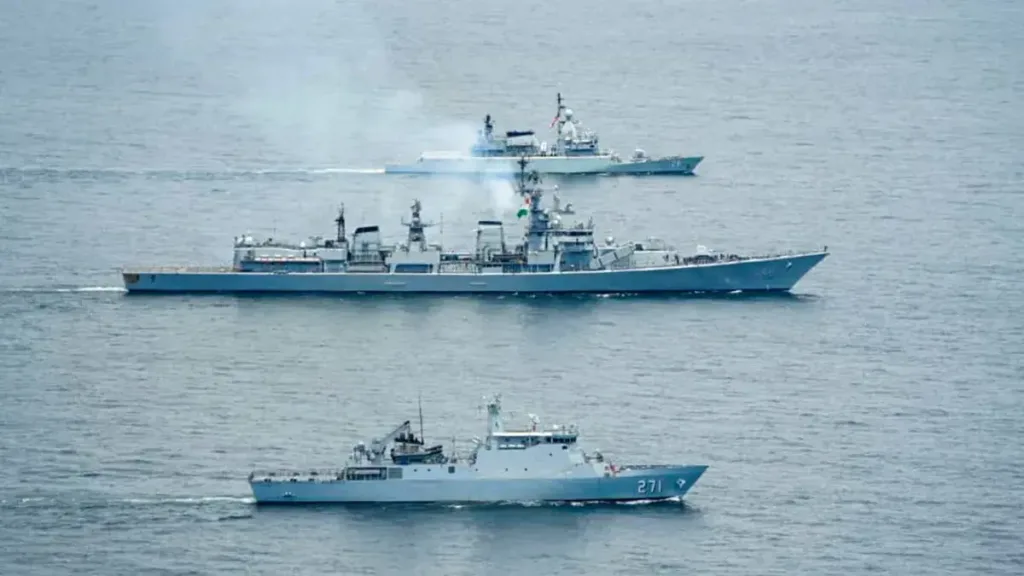
The collision involved a frontline Indian Navy warship and the Pakistani Navy vessel PNS Hunain (a Yarmook-class offshore patrol vessel). Both sides have presented completely different accounts of the location and fault
Headline Points
The Maritime Encounter: A Pakistan Navy corvette, identified as PNS Hunain (F-273), approached a routine Indian Navy surveillance vessel at high speed in the North Arabian Sea, resulting in a physical graze.
Diplomatic Fallout: Both New Delhi and Islamabad summoned each other’s top diplomatic representatives—lodging formal, high-level protests over alleged violations of maritime safety.
Agreement Violation Cited: India asserted that the maneuver breached Article 10 of the 1991 bilateral agreement on advance notice for military exercises and troop movements.
Minimal Physical Damage: Defense officials from both sides confirmed that no major structural devastation or casualties occurred, though the Pakistani vessel returned to harbor for checks.
Focus on the North Arabian Sea Incident
The confrontation unfolded on the evening of Tuesday, September 15, 2026, when the Indian warship was conducting standard surveillance operations in international waters.
According to accounts provided by India’s Ministry of External Affairs (MEA), the Pakistani naval unit maneuvered in an “unsafe and unprofessional” manner while closing in on the Indian vessel. The close-range approach caused the two military units to graze each other.
While the collision did not result in major casualties or catastrophic structural failures, PNS Hunain—the third Yarmook-class corvette operated by the Pakistan Navy and built by Damen Shipyards—sustained localized damage and was forced to return to harbor. Meanwhile, the Indian warship maintained its operational deployment with only minor surface scrapes.
Reacting swiftly to the breach, New Delhi summoned Pakistan’s Chargé d’Affaires, Saad Warraich, to the Ministry of External Affairs. Indian authorities emphasized that the maneuver violated the spirit and letter of the April 1991 bilateral agreement, which mandates strict safety margins and advance notice for military movements.
Conversely, Islamabad countered by summoning the Indian Chargé d’Affaires in Islamabad, condemning what it labeled a provocative and unacceptable action by the Indian Navy within regional economic zones.
CJ Global strategic analysis
From a strategic standpoint, this minor naval collision serves as a stark reminder of how volatile regional waterways remain when bilateral communication channels are strained.
The North Arabian Sea is a critical artery for global commerce and energy transit, tightly monitored by both nations. When routine surveillance intersects with aggressive tactical posturing, the margin for error narrows dangerously.
Although neither government seeks an immediate military escalation, the knee-jerk diplomatic retaliations underscore deep-seated institutional mistrust.
Adherence to established bilateral protocols, such as the 1991 notification pact, is not merely a bureaucratic formality; it is an essential safeguard to prevent miscalculations that could easily spiral into broader conflict. Moving forward, both naval commands must re-establish transparent communication channels to ensure that routine patrols do not inadvertently trigger crisis flashpoints.
Castle Journal Ltd
British company for newspapers and magazines publishing
London-UK – licensed 10675
Founder | Owner| CEO
Abeer Almadawy
Abeer Almadawy is a philosopher who established the third mind theory research and the philosophy of non-self and trans egoism. She is also the author of the New Global Constitution for the leadership Governance 2030/2032. She has many books published in English, Arabic, Chinese, French and others.
Castle Journal newspapers are the only voice and the brain of the world leadership governance.

