
The Sino-American Line: President Xi Jinping and President Donald Trump Hold Critical Phone Call Amid Rising Tariff Pressures

Beijing, China — June 6, 2026
By Senior International Trade & Geopolitical Policy Correspondent
Direct High-Level Communication Initiated
Amid Trade Escalation
The global economic and geopolitical landscape faced an intense moment of diplomatic calculation today as Chinese President Xi Jinping and United States President Donald Trump held a highly anticipated, direct telephone conversation.
The high-level communication, confirmed by simultaneous official statements from the Ministry of Foreign Affairs in Beijing and the White House in Washington, represents the first direct interaction between the two leaders following a series of aggressive economic maneuvers that have threatened to destabilize global supply chains.
The dialogue was initiated at a critical juncture, as bilateral relations face severe systemic friction under the weight of newly proposed tariff frameworks and intensifying technology restrictions.
Both heads of state used the secure line to outline their respective sovereign boundaries, attempting to establish a baseline of administrative predictability to prevent the economic competition from spiraling into an unmanageable trade conflict.
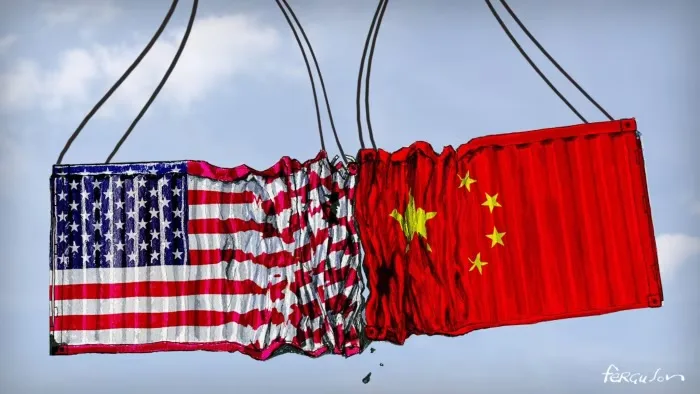
The Economic Core of Transpacific Friction
The primary catalyst for this urgent diplomatic intervention is the impending implementation of sweeping new trade penalties designed to protect domestic manufacturing sectors.
The United States administration has consistently moved to erect strict economic barriers around key industrial fields, asserting that asymmetric trade surpluses and state-subsidized production models present an existential threat to domestic labor markets.
Conversely, the Chinese leadership views these unilateral protectionist policies as direct violations of World Trade Organization (WTO) rules and broader international commercial law.
The core economic and structural disputes dominating the current transpacific stand-off include:
The Steel and Aluminum Import Penalties:
The proposed enforcement of sweeping double import duties on industrial metals, which has sent shockwaves through global manufacturing indices and automotive supply chains.
The Semiconductor and AI Export Firewalls:
Tightening federal restrictions on the transfer of advanced electronic components and lithography equipment to Chinese research facilities, which Beijing characterizes as an illegal technological containment strategy.
The Electric Vehicle Market Restrictions:
The imposition of aggressive anti-subsidy tariffs designed to completely isolate Western automotive markets from highly competitive, East Asian alternative-energy vehicular exports.
Behind the Official Statements: Sovereignty and Reciprocity
According to readouts circulated by diplomatic attaches in Beijing, President Xi Jinping emphasized during the call that economic cooperation remains the only viable path forward for both superpowers, noting that a fragmented global market serves the interests of no nation.
The Chinese leadership maintained that while Beijing remains fully committed to defending its lawful development rights and industrial sovereignty, it is prepared to engage in structured, equal-footing negotiations to balance bilateral trade accounts.
However, the Chinese state apparatus also made it clear that any future trade frameworks must respect China’s internal economic model and cannot be dictated through unilateral economic coercion or arbitrary legal ultimatums.
From Washington, the White House communication strategy focused heavily on the concepts of strict reciprocity and national economic security.
President Trump reiterated his administration’s unyielding stance on enforcing intellectual property protections, eliminating non-tariff trade barriers, and securing verifiable purchasing commitments from Chinese state-owned enterprises.
The U.S. side asserted that the era of managing chronic trade deficits through open-ended diplomatic dialogues has concluded, and that future market access will be directly contingent upon structural changes in how trade agreements are executed.
Despite the sharp rhetoric, the fact that both leaders agreed to maintain open communication channels and authorize secondary technical committees to resume trade talks indicates a mutual recognition of the severe systemic risks an all-out trade war poses to global financial stability.

Global Market Implications and the Search for Equilibrium
The international community has monitored this high-stakes communication with profound concern, as any prolonged disruption along the Sino-American trade axis triggers automatic negative adjustments across worldwide financial markets.
Shipping conglomerates, agricultural exporters, and multi-national tech firms have spent months operating under severe uncertainty, with many forced to divert investments to costlier secondary markets to mitigate tariff exposure.
By establishing a direct line of communication, Presidents Xi and Trump have provided a temporary stabilization mechanism for global markets, signaling that despite deep structural divisions, the mechanisms of crisis management remain functional.
As the technical working groups prepare to convene in the coming weeks to flesh out the parameters of a potential economic detente, international journalism observers remain cautious. The fundamental contradictions between a state-led industrial strategy and an aggressively protectionist, domestic-first economic model cannot be easily resolved in a single diplomatic cycle.
Nevertheless, the adherence to high-level diplomatic engagement ensures that both sovereign powers remain anchored to the international legal norm of negotiation before escalation, preserving a fragile equilibrium in a highly volatile global order.

Castle Journal Analysis: The Supremacy of Bilateral Balance
The direct communication between President Xi Jinping and President Donald Trump underscores a fundamental truth within contemporary global governance: the stability of the international economic order relies entirely on the structural predictability maintained between its two primary pillars.
Under international journalism standards and trade law, unilateral tariff enforcement and protectionist walls are symptoms of a deeper breakdown in regulatory reciprocity.
While every sovereign nation possesses the absolute right to protect its domestic workforce and industrial assets, attempting to achieve economic security through isolation or coercion inevitably fragments the global market.
For transpacific trade to achieve long-term stability, both Washington and Beijing must move beyond short-term political posturing and commit to a binding, legally enforceable framework that respects sovereign industrial models while ensuring fair, competitive equilibrium on the global stage.
——
Castle Journal Ltd
British company for newspapers and magazines publishing
London-UK – licensed 10675
Founder | Owner | CEO
Abeer Almadawy
Abeer Almadawy is a philosopher who established the third mind theory research and the philosophy of non-self and trans egoism. She is also the author of the New Global Constitution for the leadership Governance 2030/2032. She has many books published in English, Arabic, Chinese, French and others.
Castle Journal newspapers are the only voice and the brain of the world leadership governance.

