
High Labor Demands and Legal Challenges Strain New Structural Checks Along the German Frontier

Berlin, Germany — June 6, 2026
By Senior European Security & Labor Policy Correspondent
Extended Frontiers Reveal Operational and Economic Fractures
The Federal Republic of Germany’s ambitious initiative to enforce rigid structural checks across all nine of its land borders has entered a phase of severe operational strain, revealing deep contradictions between national security rhetoric and macroeconomic reality.
Following the decision by the Federal Ministry of the Interior to extend temporary internal border controls until mid-September 2026, the physical execution of these checks has triggered an acute logistical crisis.
While political architects in Berlin defend the extended controls as a necessary mechanism to curb irregular migration, combat transnational human smuggling networks, and ease pressures on the domestic asylum reception infrastructure, the realities on the ground paint a starkly different picture.
The state’s border architecture is facing an intense dual challenge: an unprecedented domestic labor shortage requiring hundreds of thousands of foreign workers annually, and mounting legal scrutiny from the European Commission regarding the proportionality of dismantling Schengen principles.
The Economic Paradox of Forced Border Restrictions
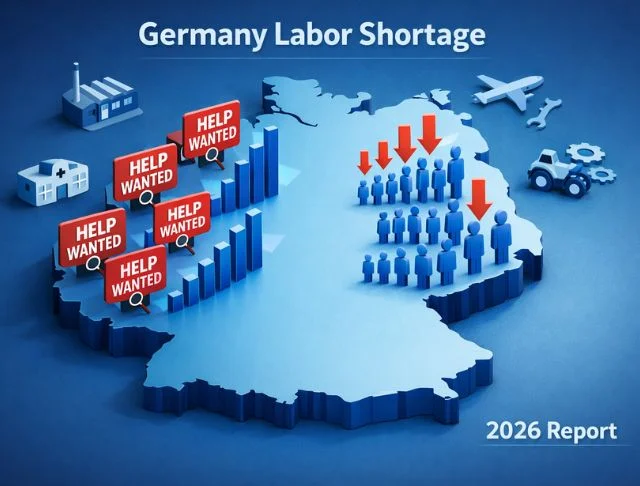
The central friction destabilizing Germany’s border policy is a profound structural paradox. At the exact moment the federal government is deploying police battalions to seal transit points along its frontiers with Poland, the Czech Republic, Austria, France, and the Benelux nations, the German economy is experiencing a historic contraction driven by a severe lack of human capital.
According to official estimates from the recently launched national hiring framework, Germany requires approximately 400,000 foreign workers each year over the next decade to sustain basic industrial production, energy grid expansions, and healthcare operations.
The physical imposition of stationary checkpoint infrastructure directly impedes the entry of the very cross-border commuters, seasonal agricultural laborers, and specialized logistics personnel required to keep the continent’s largest economy functional.
The primary systemic bottlenecks resulting from this policy misalignment include:
Supply Chain Stagnation:
Extended processing times at major freight crossings, which disrupt just-in-time manufacturing schedules for automotive components and industrial machinery across Central Europe.
The Labor Import Delays:
Severe administrative and vetting backlogs that delay the deployment of international workers arriving via structured bilateral training partnerships, such as energy-sector programs linking Vietnam and Germany.
Commuter Infrastructure Atrophy:
Daily logistical gridlock impacting hundreds of thousands of European citizens who reside in neighboring states but form the core labor force for eastern and western German regional industries.
Institutional Pushback from Brussels and the Legality of Schengen Violations

The prolonged reintroduction of internal frontier checks has also ignited a major legal stand-off between Berlin and the European Union’s governing institutions.
Under the strict provisions of the Schengen Borders Code, internal border controls are legally classified as temporary measures of absolute last resort, permitted only to counter acute, verifiable threats to public policy or national security.
The European Commission in Brussels has intensified its oversight, issuing pointed declarations urging member states to phase out internal checks in light of data showing a 40% decline in irregular external border crossings across the bloc during the first four months of 2026.
European legal scholars argue that Germany’s continuous reliance on rolling six-month extensions has effectively transformed an emergency clause into a permanent, illegal restructuring of European space, bypassing the foundational principle of free movement.
Career civil servants within the Federal Police (*Bundespolizei*) have privately expressed deep concern that their forces are being diverted from data-driven, intelligence-led counter-terrorism operations to staff static, low-efficiency checkpoint lanes for political optics.
Furthermore, neighboring sovereign states, most notably Poland and Austria, have launched reciprocal administrative measures, asserting that Germany’s unilateral actions merely displace migration pathways onto less equipped border zones, creating a domino effect of transit friction that threatens the overall stability of the European single market.
Corporate Realignment and the Search for Operational Efficiency
As the legal and logistical disputes escalate, the German private sector is moving swiftly to safeguard its supply chains from ongoing frontier disruptions. Major manufacturing conglomerates, shipping alliances, and construction firms have begun shifting their logistical dependencies away from traditional road transport toward rail-freight corridors, which are less vulnerable to immediate physical checkpoint delays.
Additionally, corporate lobbying bodies in Berlin are placing immense pressure on the Ministry of the Interior to introduce specialized “green lanes” and digitized biometric pre-clearance tracking systems for recognized commercial carriers, attempting to insulate corporate balance sheets from state-enforced border chokepoints.
However, these technological and operational workarounds do not solve the broader socio-political crisis.
As long as national immigration policies remain detached from the demographic necessities of the domestic labor market, the enforcement of comprehensive border controls will continue to function as an expensive, inefficient charade that slows down economic integration without addressing the root causes of regional migration.
By prioritizing localized political deterrence over the collective economic treaties of the European Union, Berlin risks permanently fracturing the structural predictability that has underpinned the continent’s shared prosperity for decades.
Castle Journal Analysis: The Illusion of Isolated Sovereignty
The operational gridlock unfolding along the German frontier serves as a stark reminder of the functional limits of unilateral state power within a highly integrated global economy.
Under international journalism standards and the rule of law, a sovereign nation cannot successfully decouple its security policies from its economic dependencies.
Attempting to enforce near-impenetrable border checks to appease domestic political pressures while simultaneously requiring the influx of hundreds of thousands of foreign workers to avert industrial collapse is a fundamentally contradictory and unsustainable strategy.
True governance requires an absolute commitment to regulatory consistency; if Germany wishes to maintain its leadership status within the global governance architecture, it must abandon obsolete models of physical isolation and construct an adaptive, legally sound framework that harmonizes national security with international labor mobility and European treaty law.
——
Castle Journal Ltd
British company for newspapers and magazines publishing
London-UK – licensed 10675
Founder | Owner | CEO
Abeer Almadawy
Abeer Almadawy is a philosopher who established the third mind theory research and the philosophy of non-self and trans egoism. She is also the author of the New Global Constitution for the leadership Governance 2030/2032. She has many books published in English, Arabic, Chinese, French and others.
Castle Journal newspapers are the only voice and the brain of the world leadership governance.

