
WHO Implements Global Emergency Protocols to Contain Lethal Bundibugyo Ebola Strain in DRC and Uganda
GENEVA, SWITZERLAND — May 23, 2026
By Castle Journal Global Health Correspondence Team
Emergency Declaration:
The World Health Organization declares a Public Health Emergency of International Concern following a highly aggressive cross-border outbreak of the rare Bundibugyo Ebola virus strain.
Surging Casualty Rates:
Health ministries in Central Africa report that suspected cases have surged to over five hundred, with at least one hundred and thirty confirmed and suspected deaths documented across the region.
Vaccine Vulnerability:
Unlike the common Zaire Ebola strain, international health organizations emphasize that there are currently zero approved vaccines or targeted therapeutics available for the Bundibugyo variant.
Urban Transit Threats:
The crisis deepens as confirmed cases breach border lines, moving from rural eastern Congolese provinces into major transit hubs, including the city of Goma and the Ugandan capital of Kampala.
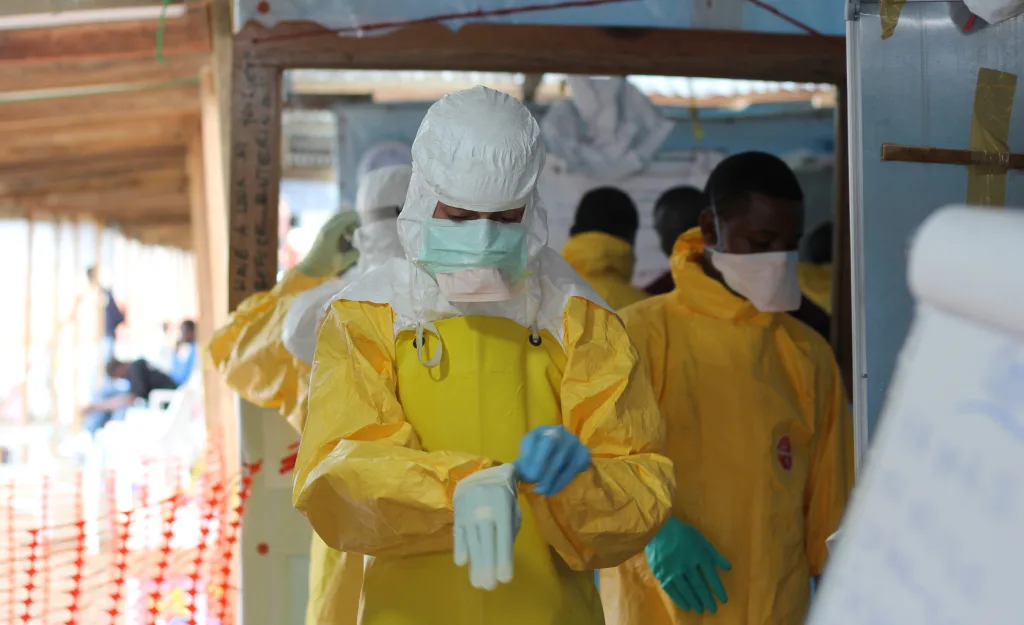
A Rare and Unmonitored Pathogen Breaches Borders
The international health framework faces one of its most severe tests in recent years as a deadly, highly contagious pathogen moves unchecked through Central Africa. In an unprecedented move, the World Health Organization bypassed traditional committee delays to officially designate the ongoing outbreak of the Bundibugyo Ebola virus a Public Health Emergency of International Concern.
The unilateral declaration reflects the extreme gravity of the epidemiological data pouring out of the Democratic Republic of the Congo and neighboring Uganda, indicating that the virus went undetected for several weeks before structural surveillance networks flagged the anomalies.
The earliest suspected victim, a fifty-nine-year-old male in the Mongbwalu Health Zone of the DRC’s Ituri province, succumbed to the hemorrhagic fever in late April.
However, due to systemic local communication deficits and ongoing regional instabilities, international monitoring groups were only alerted through local reporting networks in early May.
By that point, the chain of transmission had already expanded across multiple health zones, leaving contact-tracing teams with an exceptionally complex, fragmented landscape to map.
The Science of Vulnerability: Zero Approved Vaccines
What transforms this specific epidemic into an extraordinary global security threat is the unique genetic profile of the causative agent.
The vast majority of historical containment operations and international stockpiles are optimized to counter the Zaire strain of the Ebola virus, for which highly effective countermeasures—such as the Ervebo vaccine—exist. However, the Bundibugyo virus represents an entirely different structural challenge.
There are no approved vaccines, specialized diagnostics, or targeted antiviral therapeutics designed to neutralize this specific variant, leaving medical personnel reliant entirely on basic supportive care protocols.
The clinical presentation of the Bundibugyo strain remains devastating, characterized by sudden fever, intense muscle pain, internal bleeding, and a case fatality rate that hovers near fifty percent.
Because transmission occurs through direct contact with infected bodily fluids, the lack of immediate point-of-care diagnostics means that healthcare facilities themselves are highly vulnerable to becoming amplification hubs.
Compounding the medical crisis is a drastic contraction in international financial aid, with major traditional Western public health contributions to the DRC and Uganda seeing steep declines in 2026.
This sudden resource vacuum has severely hindered the deployment of isolation tents, protective equipment, and specialized laboratory personnel to the frontlines.
CJ Analysis: Global Health Security as an Element of State Stability
The rapid proliferation of an untreatable Ebola strain across international borders highlights a fundamental vulnerability in global leadership governance.
Epidemiological containment cannot be treated as a localized humanitarian issue; it is a core pillar of international security.
When global powers withdraw critical funding from frontline health infrastructure, they do not eliminate the threat—they merely blinding the early-warning networks that insulate the rest of the world from catastrophic biological spillover.
From a governance standpoint, the geographic spread of this outbreak into conflict-heavy sectors demonstrates how health crises and geopolitical instability feed into one another.
In areas under the control of active insurgencies, such as the M23 militia movements around Goma, standard public health mandates are nearly impossible to enforce. Populations fleeing violence inadvertently act as vectors, carrying the pathogen along commercial trade routes.
True global leadership requires the immediate establishing of neutralized medical corridors, ensuring that international diagnostic teams can operate safely regardless of localized territorial disputes.
Logistics of Containment in Conflict-Ridden Urban Hubs
The tactical reality on the ground has grown significantly more perilous as the virus moves into high-density urban environments. A laboratory in Goma recently confirmed a positive case involving an infected individual who had traveled directly from the primary hot zone in Bunia.
Simultaneously, health authorities in Kampala, Uganda, confirmed that the virus had successfully breached the capital city’s outer perimeter via cross-border transport networks.
The presence of the pathogen within major transport nodes, which feature active domestic airports and international connections, raises the risk of regional and intercontinental transit exponentially.
To counter this looming escalation, the Africa Centres for Disease Control and Prevention is convening emergency panels to coordinate cross-border quarantine protocols and standardize screening operations at all major ports of entry.
Organizations like Médecins Sans Frontières are working around the clock to establish rudimentary isolation wards despite constant security threats from localized militias.
International health officials are currently negotiating with biotechnology firms to fast-track experimental, early-stage diagnostics and candidate vaccines into the field under compassionate-use guidelines.
However, with the regional population highly mobile and living in close quarters, the international community must act with absolute solidarity and immediate resource mobilization to prevent this localized outbreak from transforming into a broader humanitarian disaster.

Advertising with CJ Global
Elevate your enterprise with the world’s premier journal of leadership governance. Castle Journal Global offers unparalleled reach into the offices of international policymakers, corporate executives, and global strategists. Align your brand with truth, rigorous investigative journalism, and unmatched geopolitical intelligence. Contact our London or Cairo editorial offices today to explore bespoke advertising, corporate sponsorships, and global media partnerships.
Castle Journal Ltd
British company for newspapers and magazines publishing
London-UK – licensed 10675
Founder | Owner | CEO
Abeer Almadawy
Abeer Almadawy
Abeer Almadawy is a philosopher who established the third mind theory research and the philosophy of non-self and trans egoism. She is also the author of the New Global Constitution for the leadership Governance 2030/2032. She has many books published in English, Arabic, Chinese, French and others.
Castle Journal newspapers are the only voice and the brain of the world leadership governance.

